Configure quality categories and root causes
Build the site catalogues for defect type categories (with severity) and 5M+E root cause codes that quality issues, holds, and analysis pickers use.
Quality categories and root causes are the two site catalogues that keep defect classification consistent. Quality categories name the type of defect — surface mark, dimensional error, contamination — and carry a default severity. Root causes name why it happened, grouped with the 5M+E method (Material, Equipment, Process, Operator, Environment, plus Design, Supplier, and Other).
Configure both when you open a plant for quality work, adopt a standard defect vocabulary, or prepare operators and quality leads to log issues without inventing free-text labels each time. Day-to-day issue logging, holds, and analysis pick from these lists; you return here to maintain them, not to work each ticket.
Before you start
Both areas live under Settings → Quality in the left sidebar:
| Area | How you open it | Page address ends in |
|---|---|---|
| Categories | Settings → Quality → Categories | /settings/quality/categories |
| Root Causes | Settings → Quality → Root Causes | /settings/quality/root-causes |
Neither item carries a Beta badge. The sidebar labels are short (Categories, Root Causes); the page headers use the fuller titles Quality Categories and Root Causes.
You need the matching permissions for the selected site:
| Area | View | Create, edit, reorder, import | Delete / archive |
|---|---|---|---|
| Quality categories | View quality categories (quality_categories.view) | quality_categories.create, quality_categories.update | quality_categories.delete |
| Root causes | View root causes (root_causes.view) | root_causes.create, root_causes.update | root_causes.delete (archives) |
Built-in roles that include full access to both catalogues include Entity admin, Manager, Master data, and Super user. The built-in Quality role can manage quality categories but does not include root-cause permissions — pair it with another role or grant root_causes.* if the same people maintain both lists. Tablet user can view quality categories only. If create, import, or archive fails, ask an administrator to adjust roles.
Both catalogues are per site (entity). Switching plant changes which categories and root causes you see. Set them up separately for each site that needs its own vocabulary.
Quality categories
What the Quality Categories page shows
The page header is Quality Categories, with the description Manage defect type categories for quality issue classification. Two actions sit in the header:
- Import Presets — add a starter set for your industry (existing codes are skipped).
- Add Category — create a single category by hand.
The table lists categories for the current site, including inactive ones, ordered by the site’s sort order. Columns:
| Column | What it shows |
|---|---|
| (icon) | Icon and color chip for the category |
| Code | Short unique code (for example DEF-SURFACE) |
| Name | Display name used in pickers |
| Severity | Low, Medium, High, or Critical |
| Description | Optional notes, or - if none |
| Status | Active or Inactive |
Rows are drag-ordered: use the drag handle on a row to change the order pickers and lists use. Order is saved for the site when you drop a row.
Each row has an actions menu with Edit, Deactivate or Activate, and Delete.
If the site has no categories yet, the empty state reads No quality categories yet with the description Create your first quality category to classify defects and quality issues. and an Add Category action.
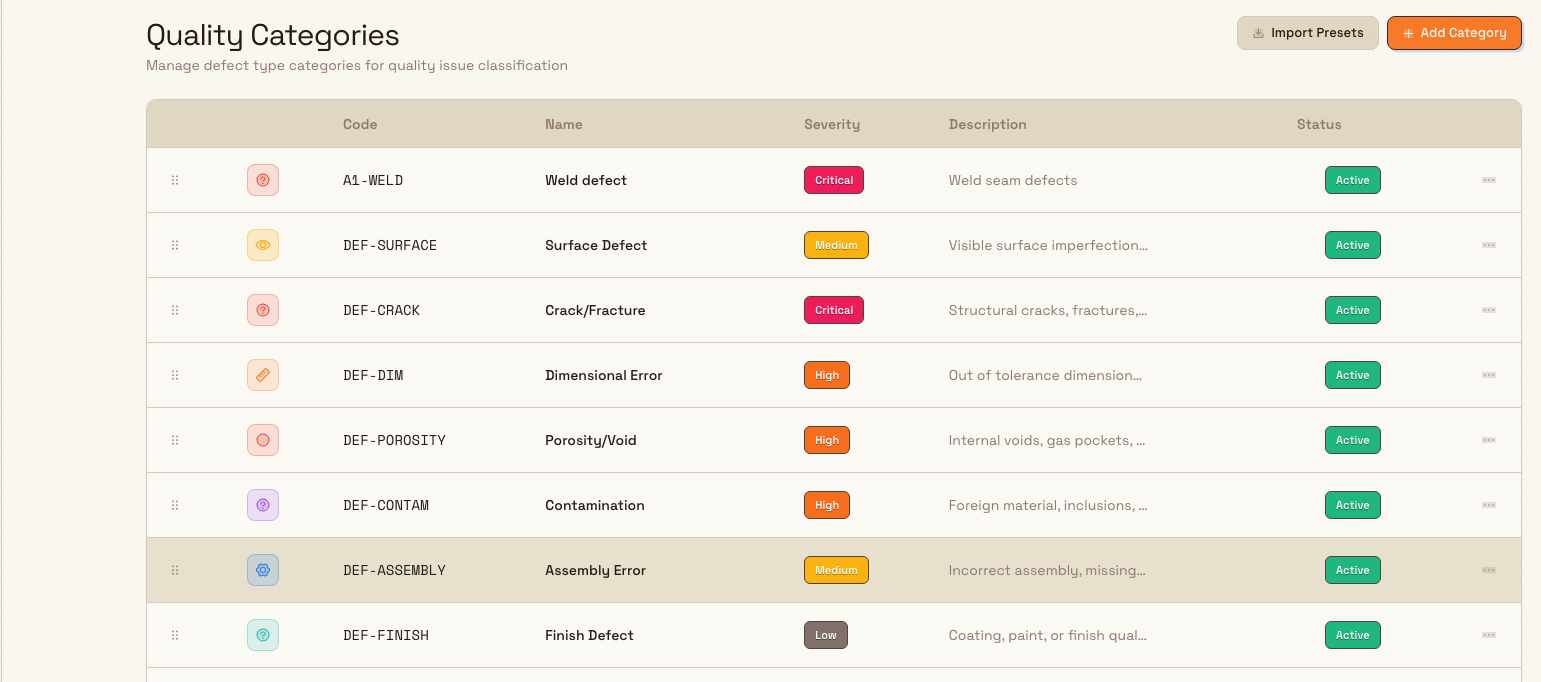
administration.quality.categories-root-causes-01
Severity levels
Every category has one severity. The badges in the table use these labels:
| Severity | Typical use |
|---|---|
| Low | Documentation, labelling, or minor cosmetic issues |
| Medium | Common process or assembly defects that need tracking |
| High | Out-of-tolerance dimensions, contamination, or serious functional defects |
| Critical | Structural cracks, fractures, or defects that block release |
Severity travels with the category into quality workflows that filter or report on defect type. Choose the level that matches how your plant prioritises that class of defect.
Import industry presets (categories)
The fastest way to start is to import an industry preset pack. Import always includes the generic universal categories, then adds industry-specific categories for the pack you choose.
- Select Import Presets. The Import Quality Category Presets dialog opens.
- Under Select Industry, choose a pack. Labels include Generic (All Industries), Non-Destructive Testing (NDT), Food & Beverage, Automotive Manufacturing, Pharmaceutical / Life Sciences, Packaging, Electronics / Semiconductor, Plastics / Injection Molding, Metal Fabrication / CNC, and Chemical Processing.
- Note the dialog text: categories that already exist (by code) will be skipped, and generic presets are included along with industry-specific ones.
- Select Import Presets.
Bulk creates any codes that are not already present for this site and skips categories whose codes already exist. A success toast reports how many were created (and how many skipped); if every code already exists, an info toast reports No new categories.
Generic categories that ship with every import include:
| Code | Name | Severity (typical) |
|---|---|---|
DEF-SURFACE | Surface Defect | Medium |
DEF-CRACK | Crack/Fracture | Critical |
DEF-DIM | Dimensional Error | High |
DEF-CONTAM | Contamination | High |
DEF-ASSEMBLY | Assembly Error | Medium |
DEF-DOC | Documentation Error | Low |
DEF-OTHER | Other | Medium |
After import, edit any row to match your plant’s language — presets are a starting catalogue, not a final policy.
Add a quality category by hand
- Select Add Category. The Create Quality Category dialog opens (Add a new defect type category).
- Fill in the fields:
- Name — required, up to 100 characters (placeholder example:
Surface Defect). - Code — generated from the name with a
DEF-prefix (for exampleSurface DefectbecomesDEF-SURFACE_DEFECT). The field is read-only; you cannot type a custom code. Codes are unique within the site (max 20 characters). - Severity — Low, Medium, High, or Critical (default Medium).
- Icon — icon for the table and pickers (default Warning).
- Color — accent for the icon chip (system color picker; transparent is allowed and clears the color). Default accent is warning.
- Description (optional) — free-text notes, up to 500 characters.
- Name — required, up to 100 characters (placeholder example:
- Select Create.
A success message confirms Quality category created with the name and code. The new row appears with Active status, appended to the current order.
If a code already exists for the site, save fails with A quality category with code "…" already exists in this facility.
Edit, activate, deactivate, or delete a category
- Edit — opens Edit Quality Category (Update quality category details). Change name, severity, icon, color, or description. The code stays derived from the name (read-only) and updates when the name changes. Select Save Changes; the toast confirms Quality category updated.
- Deactivate / Activate — toggles whether the category is available for new picks without removing it. Confirmations read Category deactivated or Category activated. Prefer deactivate when you want history to keep the label but stop new use.
- Delete — opens Delete Quality Category. The dialog asks whether you are sure you want to delete the category by name and code, states that This action cannot be undone, and notes that This will fail if any quality issues are using this category. Confirm with Delete. Success reads Quality category deleted.
If issues still reference the category, Bulk rejects the delete with Cannot delete quality category: It is referenced by existing quality issues. Deactivate it instead.
Root causes
What the Root Causes page shows
The page header is Root Causes, with the description Manage root cause codes for defect analysis (5M+E methodology). On the Active tab, two actions sit in the header:
- Import Presets — add a starter 5M+E set for your industry (existing codes are skipped).
- Add Root Cause — create a single root cause by hand.
The page has two tabs:
| Tab | What it shows |
|---|---|
| Active | Non-archived root causes for the site (including inactive ones), drag-ordered |
| Archived | Soft-deleted root causes you can Restore |
Active table columns:
| Column | What it shows |
|---|---|
| (icon) | Icon and color chip |
| Code | Short unique code (for example RC-MAT-01) |
| Name | Display name used in analysis pickers |
| Category | 5M+E group: Material, Equipment, Process, Operator, Environment, Design, Supplier, or Other |
| Description | Optional notes, or - if none |
| Status | Active or Inactive (or Archived on the Archived tab) |
On Active, the row menu offers Edit, Deactivate or Activate, and Archive. On Archived, the menu offers Restore only; drag reorder is disabled.
If the site has no active root causes yet, the empty state reads No root causes yet with the description Create your first root cause to analyze defects using the 5M+E methodology. and an Add Root Cause action. An empty Archived tab reads No archived root causes with Root causes you archive will appear here and can be restored.
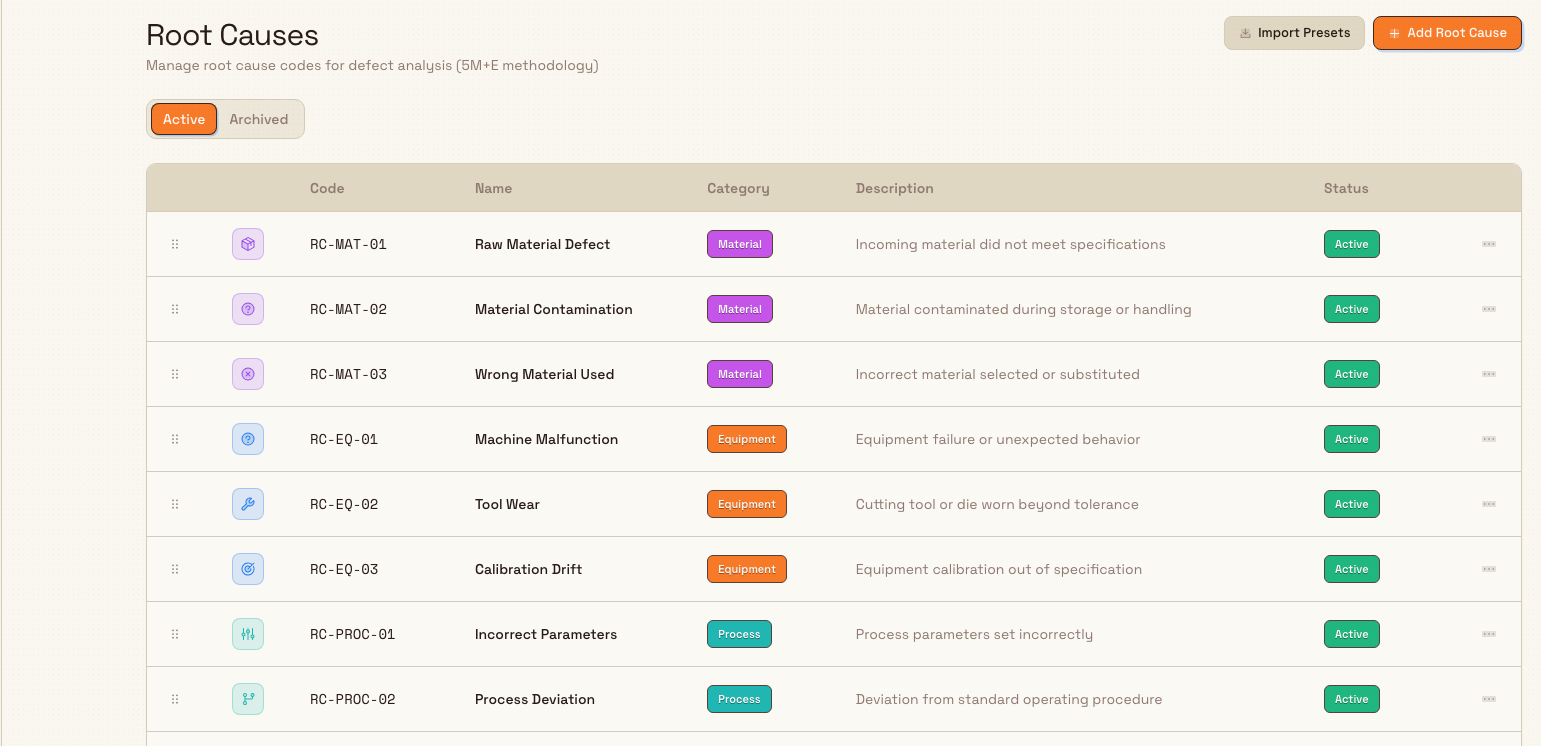
administration.quality.categories-root-causes-02
5M+E categories
Every root cause belongs to one analysis group:
| Category | Typical meaning |
|---|---|
| Material | Incoming or substituted material, contamination, wrong grade |
| Equipment | Machine failure, tool wear, calibration drift |
| Process | Wrong parameters, skipped steps, unstable process |
| Operator | Training gaps, incorrect handling, human error |
| Environment | Temperature, humidity, cleanliness, utilities |
| Design | Specification or design issues |
| Supplier | Vendor quality or delivery problems |
| Other | Uncategorised causes |
These groups organise Pareto-style analysis and filter pickers. They are independent of quality categories: a surface defect might have a material, process, or operator root cause depending on the investigation.
Import industry presets (root causes)
- On the Active tab, select Import Presets. The Import Root Cause Presets dialog opens (industry selection mirrors quality categories).
- Under Select Industry, choose a pack — the same industry labels as quality categories, from Generic (All Industries) through Chemical Processing.
- Note that root causes that already exist (by code) are skipped.
- Select Import Presets.
Bulk creates missing codes and skips existing ones. Success reports how many root causes were created; if nothing new was needed, an info toast reports No new root causes.
Generic root causes that ship with every import include examples such as:
| Code | Name | Category |
|---|---|---|
RC-MAT-01 | Raw Material Defect | Material |
RC-MAT-02 | Material Contamination | Material |
RC-EQ-01 | Machine Malfunction | Equipment |
RC-EQ-02 | Tool Wear | Equipment |
RC-PROC-01 | Incorrect Parameters | Process |
RC-OP-01 | Training Gap | Operator |
Industry packs add further codes for that sector. Edit names after import if your plant uses different wording.
Add a root cause by hand
- Select Add Root Cause. The Create Root Cause dialog opens (Add a new root cause code for defect analysis).
- Fill in the fields:
- Name — required, up to 100 characters (placeholder example:
Raw Material Defect). - Code — generated from the name with an
RC-prefix (for exampleTraining GapbecomesRC-TRAINING_GAP). The field is read-only. Codes are unique within the site (max 20 characters). - Category (5M+E) — one of the eight groups above (default Other).
- Icon — chosen from the fixed icon list (default Question).
- Color — accent for the icon chip (system color picker; transparent clears the color).
- Description (optional) — free-text notes, up to 500 characters.
- Name — required, up to 100 characters (placeholder example:
- Select Create.
A success message confirms Root cause created with the name and code. New rows start Active.
If a code already exists, save fails with A root cause with code "…" already exists in this facility.
Edit, activate, archive, or restore a root cause
- Edit — opens Edit Root Cause (Update root cause details). Change name, 5M+E category, icon, color, or description. The code stays derived from the name. Select Save Changes; the toast confirms Root cause updated.
- Deactivate / Activate — hides or restores the code in active pickers without archiving. Confirmations read Root cause deactivated or Root cause activated.
- Archive — opens Archive Root Cause. The dialog asks you to archive the code by name and code, states that it will move to the Archived tab and can be restored later, and notes that This will fail if any quality issues are using this root cause. Deactivate it instead. Confirm with Archive. Success reads Root cause archived (moved to the Archived tab). If issues still reference the code, Bulk rejects the archive with Cannot delete root cause: It is referenced by existing quality issues. Deactivate it instead.
- Restore — on the Archived tab, open Restore, confirm in Restore Root Cause (Restore "…" (…) to the Active list?), and select Restore. Success reads Root cause restored (active again). If another non-archived code already uses the same code string, restore fails with the duplicate-code facility error until you resolve the clash.
Example: Leeds Fabrication Plant quality catalogues
Granite Peak Manufacturing runs the Leeds Fabrication Plant, where fabricated brackets are inspected before ship. Dana Winters opens Settings → Quality → Categories, selects Import Presets, chooses Metal Fabrication / CNC, and imports. The table fills with generic defects (surface, crack, dimensional, contamination, assembly, documentation, other) plus any metal-fab extras in that pack. She renames Other’s description to match the plant’s scrap form wording and deactivates a category the floor never uses.
She then opens Root Causes, imports the same industry pack, and confirms Material, Equipment, and Process codes such as Raw Material Defect, Tool Wear, and Incorrect Parameters. She adds a custom root cause named Fixture misaligned, which receives a generated RC- code, sets its 5M+E category to Equipment, and drags it next to the other equipment causes. From then on, when quality issues are logged at Leeds, pickers show these categories and root causes instead of free text.
Expected result
After you import or create entries:
- Quality Categories lists ordered Active defect types with severity, codes, and icons. Quality issue forms and related pickers can offer those categories for the site.
- Root Causes lists ordered Active 5M+E codes. Analysis and issue workflows that set a root cause can offer those codes; archived codes stay available for restore and no longer appear on the Active tab.
Inactive items remain on their settings pages but are excluded from typical operational lists that load only active rows.
Feature state and limits
Configuring quality categories and root causes is a generally available feature. Keep these behaviors in mind:
- Both catalogues are per site (entity); they are not shared across plants.
- Codes are unique per site, stored uppercase, and auto-generated from the name in the UI (
DEF-…for categories,RC-…for root causes). You cannot free-type a code in the create/edit dialogs. - Categories and root causes are independent — any category can pair with any root cause on a given issue.
- New items are created Active. Prefer Deactivate when something is still referenced by issues; Delete (categories) and Archive (root causes) are blocked while quality issues reference them.
- Category delete is soft and has no restore tab in the UI. Root-cause archive is soft and can be restored from the Archived tab.
- Industry import always seeds the generic set first, then industry extras, and skips codes that already exist.
- The built-in Quality role manages categories but not root causes unless you add
root_causes.*permissions.
Troubleshooting
- "A quality category with code "…" already exists in this facility" / "A root cause with code "…" already exists in this facility" — rename the item so the generated code differs, or edit the existing row instead of creating a duplicate. Restore can hit the same error if an active code already uses that string.
- "Cannot delete quality category: It is referenced by existing quality issues. Deactivate it instead." — at least one quality issue still uses the category. Deactivate it, or reassign those issues, then delete if you still need it gone.
- "Cannot delete root cause: It is referenced by existing quality issues. Deactivate it instead." — same pattern for root causes when you try to Archive. Deactivate for day-to-day retirement while history remains linked.
- Import creates zero new rows — every code in that pack already exists for this site. The toast reports skipped counts; edit existing rows or use a different industry pack for additional codes.
- Root Causes actions fail while Categories work — the Quality role includes category permissions but not root-cause permissions. Grant
root_causes.view/create/update/deleteor assign Entity admin, Manager, Master data, or Super user. - Add, Import, Edit, Delete, or Archive is missing or fails — you may have view-only access. Ask an administrator for the matching create/update/delete permissions or a management role.
Related
- Create a quality issue — log issues that pick from these categories and root causes.
- Review and close a quality issue — investigate and close issues using the same catalogues.
- Quality overview — the wider quality module.
- Resolve a quality problem — end-to-end problem resolution workflow.
- Roles and permissions — grant
quality_categories.*androot_causes.*. - Configure downtime reasons — a similar per-site catalogue pattern for OEE stop codes.
Configure downtime reasons
Build the site catalogue of stop reasons operators pick when pausing production — classify each by OEE category and loss type, require comments when needed, and import industry presets.
Configure safety types and settings
Build the site catalogue of incident types used when people report safety incidents — create types by hand, import industry presets, and jump to related safety audit settings.