Review production consumption
See how much stock production has drawn down in a consumable's movement timeline, where Production Usage and Reversal entries show running balances.
Last updated
When an operator records that they used a consumable on a production job, Bulk removes that quantity from your inventory. A consumable is any material you stock and draw down as you work, such as welding wire, cutting discs, adhesive, or coolant. Each of these draw-downs is stored as a stock movement of type Production Usage, and reviewing them tells you exactly how much material a job, an asset, or a shift actually consumed.
This article explains where production consumption appears, how to read a consumable's movement timeline, and how to tell a genuine usage from a correction. It is a review task: you are reading what production already booked, not entering new usage yourself. Usage itself is captured on the production side when operators record consumable use against their jobs.
Before you start
You review production consumption from the Inventory area, so you need access to it:
- Permission. Viewing stock levels and movements requires the
inventory.stock.viewpermission. In a standard setup every operational role has it, including operators, so most people who work in production can open and read these timelines. Receiving or adjusting stock is a separateinventory.stock.managepermission, but you do not need it just to review consumption. - Stock tracking must be on. A Production Usage entry is only created when the consumable variant has stock tracking enabled. If an operator records usage for a variant whose tracking is off, the usage is still attached to the job for costing, but no stock movement is written and nothing appears in the timeline described below.
- The right facility. Stock movements are scoped to the facility (entity) you are currently working in. If you cannot find expected consumption, confirm you are in the facility where the work was recorded before you keep looking.
Where consumption comes from
Production Usage entries are generated automatically when operators record consumable use on the shop floor. You never type them into the Inventory area by hand. To understand how the numbers are captured in the first place, see the production-side guide linked at the end of this page.
Open the Stock area
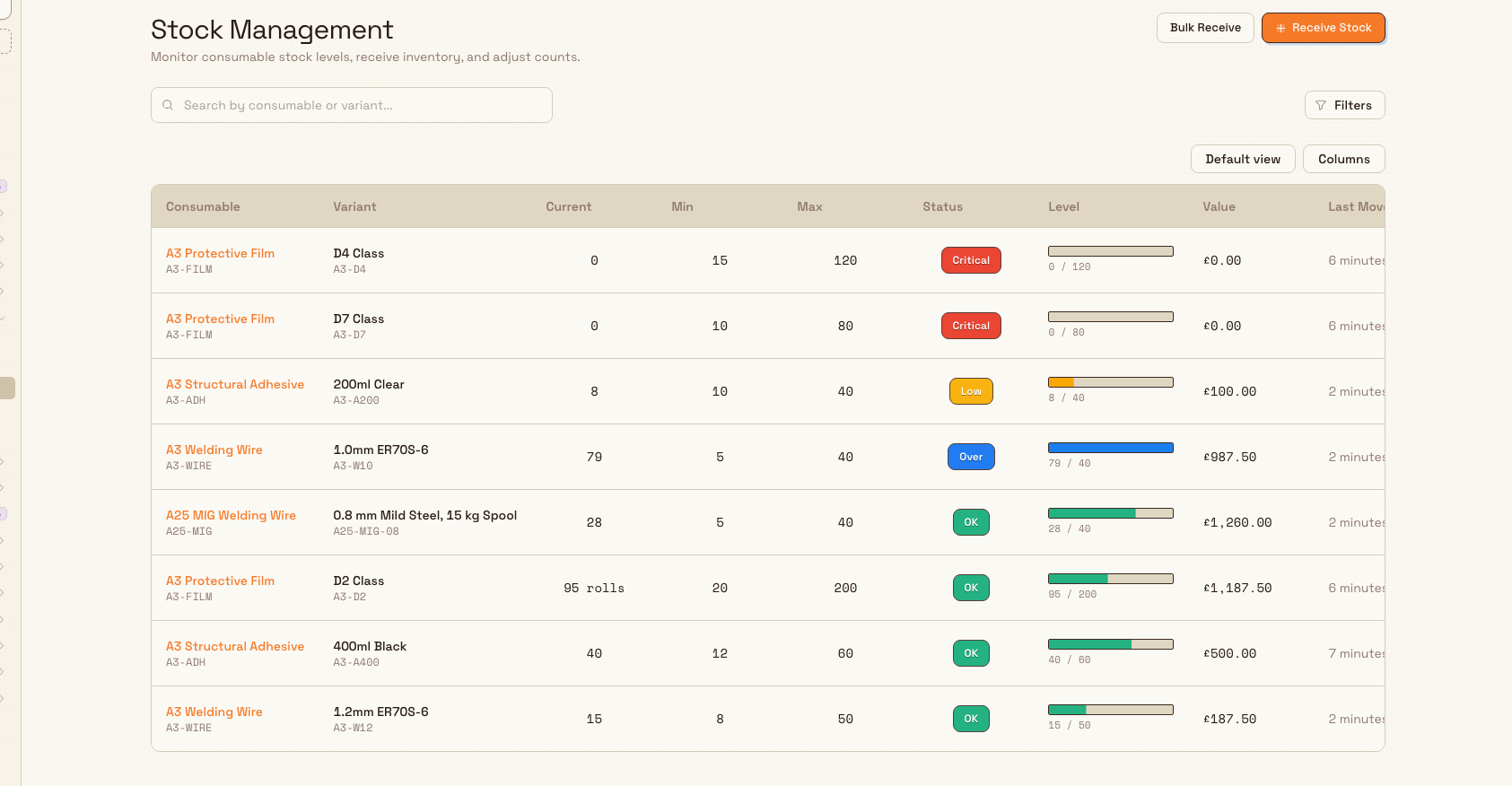
From the left navigation, open Inventory and choose Stock. This opens the Stock Management page, described as "Monitor consumable stock levels, receive inventory, and adjust counts."
The page lists one row per tracked consumable variant, with columns for Consumable, Variant, Current (quantity on hand), Min, Max, Status, Level, Value, and Last Movement. The Status column shows a badge of OK, Low, Critical, Over, or Untracked, and the Last Movement column is your first clue about which variants have recent activity worth opening.
Read a consumable's movement timeline
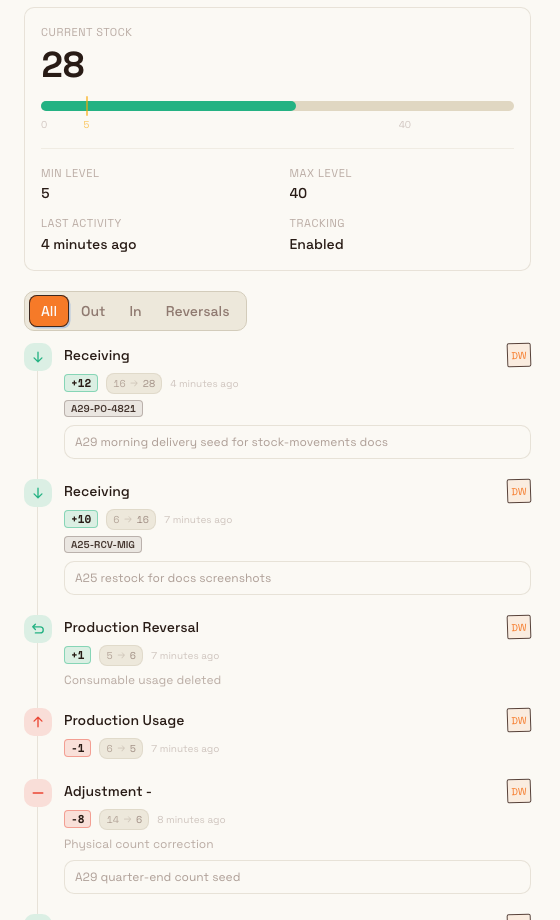
Select any row to open the stock detail sheet on the right. The top of the sheet names the consumable and its variant, shows the current status badge, and presents the Current stock figure. Below that you see the variant's Min Level and Max Level, its Last Activity, and whether Tracking is Enabled or Disabled.
Underneath the summary is the movement timeline. This is where production consumption lives. Each entry shows:
- The movement type label, such as Production Usage for a draw-down, Production Reversal for a correction that puts stock back, or Cut Remainder for a tiny leftover written off after part amounts (see Understand cut remainders).
- Who recorded it, shown as an avatar you can hover to see the name.
- A quantity badge, with a minus sign for stock going out and a plus sign for stock coming in.
- The running balance, shown as the balance before the movement, an arrow, and the balance after.
- How long ago it happened.
When there is a mix of activity, the timeline offers filter tabs above it: All, Out, In, and Reversals. Out groups the movements that removed stock, which is where a Production Usage lands. Reversals isolates Production Reversal entries so you can separate genuine consumption from corrections at a glance. Tabs only appear when there is more than one group to show.
Other movement types can share the same timeline, including Receiving, Adjustment +, Adjustment -, Initial Stock, and Reconciliation. Focus on Production Usage, Production Reversal, and Cut Remainder when your question is specifically about what production consumed.
Example: fixture cleaning at Gotham Applied Sciences
Wayne Corp prepares a housing fixture at Gotham Applied Sciences. A supervisor wants to check how many tubs of cleaner the first-off trial used.
They open Inventory, choose Stock, and select Gotham Fixture Cleaner, variant Pre-saturated wipes, tub of 100. The current stock is 22, with a status of OK. The timeline shows an initial balance of 24 and a Production Usage of three tubs, reducing stock from 24 to 21.
The operator later returned one sealed tub and corrected the recorded quantity from three to two on the production step. Bulk wrote a Production Reversal of one tub, raising the balance from 21 to 22. The original usage remains visible beside the reversal, so the supervisor can follow the correction and confirm net consumption was two tubs.
Understand reversals
A Production Reversal is how Bulk undoes a recorded consumption, for example after a mis-scan or a scrapped unit. It adds the reversed quantity back to stock and is labelled so you can tell it apart from a genuine receipt of new material. Because a reversal is a distinct entry rather than an edit to the original, the timeline keeps a complete, honest history: the original Production Usage stays visible and the reversal sits alongside it. Use the Reversals tab when you want to review only these corrections.
Understand cut remainders
Operators often log part units, such as half or a third of a film sheet. Bulk keeps amounts to 2 decimals, so a third is recorded as 0.33, and three thirds add up to 0.99 rather than a whole sheet. Without a correction, 0.01 of a sheet would stay on the balance that nobody can use.
After a recording with a part amount, Bulk checks the variant's balance. When it sits 0.01 or less above a whole number, Bulk writes that leftover off as its own Cut Remainder movement, and the balance lands on the whole number. For example, with 10 sheets on hand, three recordings of 0.33 take the balance to 9.01, and a Cut Remainder of 0.01 brings it to 9.
A cut remainder:
- Appears in the timeline as a separate entry with a minus quantity, next to the Production Usage entry that caused it.
- Is linked to the same recording and job, with the reason "Cut remainder written off".
- Changes stock only. The usage on the job, and its cost, keep the amount the operator entered.
When that recording is later edited or deleted, Bulk reverses the write-off with a Cut Remainder entry that has a plus quantity and the reason "Cut remainder reversed". After an edit, Bulk checks the corrected amount again and writes off a new leftover if one remains. As with every movement, the original entry stays in the history.
The rule only applies to stock-tracked variants, to recordings with a part amount, and to balances of 0 or more, and it never writes off more than 0.01. Larger differences, such as sixths recorded as 0.17 that add up to 1.02, are left for a stock count to correct.
What you can and cannot do here
- This area is read-only for consumption. You review Production Usage, Production Reversal, and Cut Remainder entries, but you do not create or reverse consumption from the Inventory Stock page. Those actions happen when production records or corrects consumable use.
- The timeline is per variant. Each detail sheet covers a single consumable variant in the current facility. To compare several materials, open each variant in turn, or use the production and dashboard views linked below for a broader roll-up.
- Entries only exist for tracked variants. Consumption recorded against a variant with tracking disabled is kept for costing on the job but never appears as a stock movement here.
Feature state
Reviewing production consumption is generally available and part of the standard Inventory Stock area. It reflects live stock movements as production records them, so the timeline stays current without any manual refresh on your part.
Troubleshooting
An operator recorded usage but you see no Production Usage entry. The most common cause is that stock tracking is disabled for that variant. Open the detail sheet and check the Tracking field. If it shows Disabled, enable stock tracking on the consumable variant so that future usage deducts and appears here. Turning tracking on does not retroactively create movements for usage that was already recorded while tracking was off.
The timeline looks empty for a brand-new variant. If nothing has been received, set as initial stock, or consumed yet, the sheet shows "No movements yet" with the message "Stock movements will appear here as inventory is received, used, or adjusted." This is expected until the first movement is recorded.
A small Cut Remainder entry follows a Production Usage entry. This is expected when operators log part amounts. Bulk wrote off a leftover of 0.01 or less so the balance lands on a whole unit. Editing or deleting the recording on the production side reverses it.
You expected consumption but are in the wrong place. Movements are scoped to the facility you are working in and to one variant at a time. Confirm you selected the correct facility and the exact variant the operator used, since two similar variants can hold very different histories.
Related guidance
- Record consumable use explains how operators book the usage that becomes Production Usage here.
- Review production transactions gives a production-side view of recorded activity.
- Review stock levels covers the quantities and statuses shown on the Stock Management page.
- Record a stock movement covers receiving and adjusting stock by hand.
- Manage consumables and variants explains how variants and their stock tracking are set up.
- Inventory overview links the rest of the inventory guides.
Respond to a stock alert
Notice, act on, and configure the low, critical, and over-stock alerts Bulk raises for tracked consumable variants at your site.
Finance
The Finance area in Bulk: create, approve, issue, and confirm production invoices, raise customer credit notes, and open the guide for each task.