Review KPI detail and reports
Open a single KPI to review its definition and full change history, and open a daily report to review or update the manual KPI values recorded for a site on a date.
A KPI (key performance indicator) in Bulk is a named measure of performance — such as on-time delivery, first pass yield, or safety incidents — with a unit, a target, and a rule that decides whether each day passes or fails. This page covers the two places where you review KPIs after they have been set up: the KPI detail view for one KPI's definition and its complete change history, and the daily report, where the manual KPI values for one site are entered, reviewed, and corrected.
In Bulk a site (also called an entity) is one plant or facility, and both surfaces are scoped to a single site. A report is the set of manual KPI values recorded for one site on one date, saved together as a dated snapshot. You review a KPI's detail to confirm how it is configured and to see who changed its target or a recorded result; you open the daily report to enter the day's numbers or to check and update what was submitted earlier.
Before you start
Two different permissions cover the two surfaces, so which one you have decides what you can open:
- View a KPI's detail. Opening a KPI's detail page and reading its audit log requires the View KPIs permission (
kpi.view). It is granted by default to the Super user, Entity admin, Manager, and Dashboards roles. - Enter a report. Opening the daily report form and submitting values requires the Enter KPI values permission (
kpi.entry). It is granted by default to the Super user, Entity admin, Manager, and Operator roles. - A selected site. Both surfaces need a site in context. The detail page asks you to select one if none is active, and the report is always tied to a specific site.
The two permissions are deliberately separate. An Operator holds kpi.entry but not kpi.view, so a shop-floor operator can file the daily report but cannot open the KPI detail page. A Dashboards-role user is the reverse: they can review a KPI's detail and history but cannot enter report values.
Review a KPI's detail
You reach a KPI's detail from the KPI list. Open Settings, then KPI, then Management to reach the KPI Management page, and select a KPI to open its detail view.
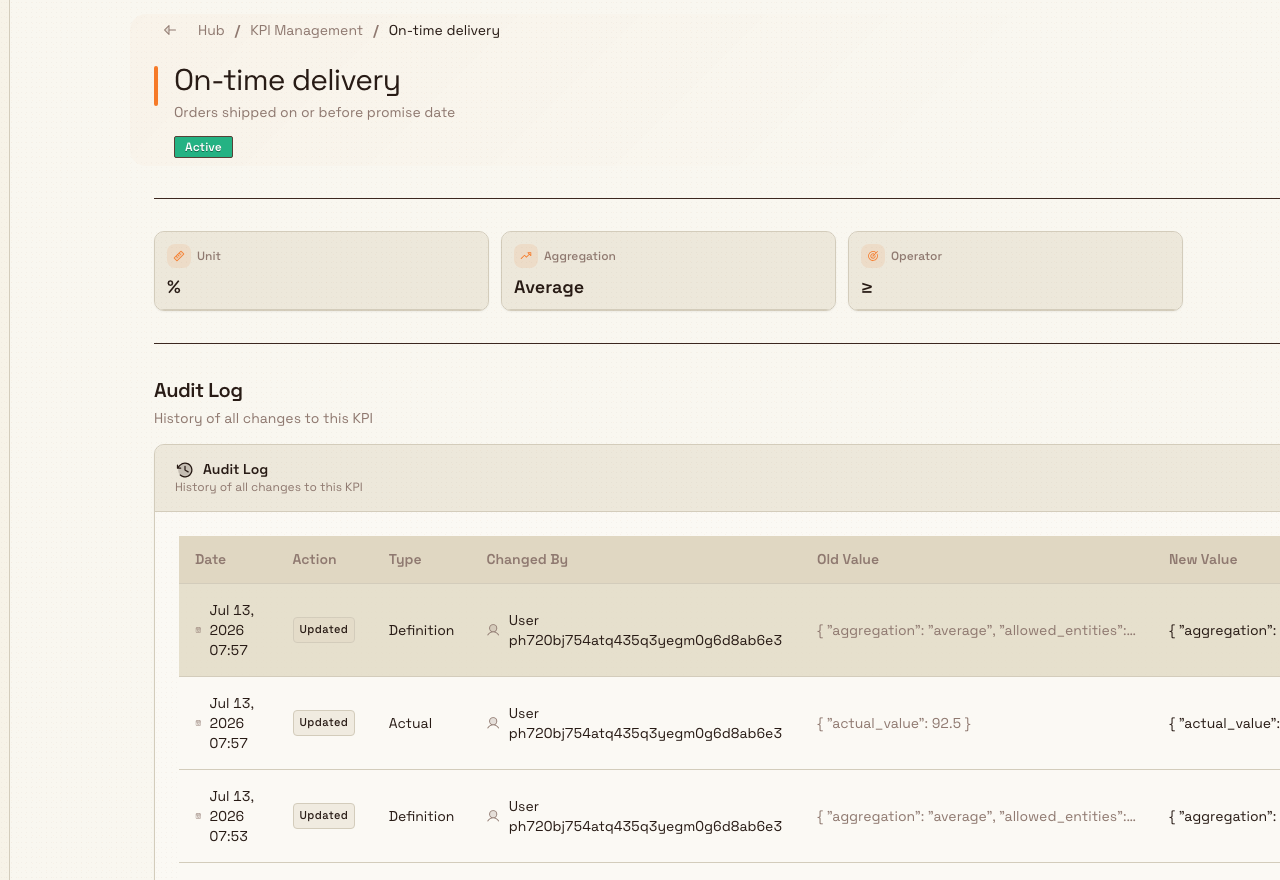
The detail view opens with the KPI's name and description at the top, a breadcrumb reading Hub, then KPI Management, then the KPI name, and a back arrow that returns you to KPI Management. An Active badge appears next to the name when the KPI is switched on.
Below the header, three summary cards describe how the KPI is measured and judged:
- Unit — how the value is expressed, for example a percentage, a currency amount, or a plain count.
- Aggregation — how daily values combine into a period figure: Sum, Average, Max, or Min.
- Operator — the comparison used against the target to decide pass or fail: greater than or equal to (≥), less than or equal to (≤), or equal to (=). For example, an on-time delivery KPI with a target of 95 percent and a ≥ operator passes on any day the actual result reaches or beats 95 percent.
kpi.reports-01
The change history (Audit Log)
The Audit Log section on the detail page lists every change made to the KPI, so you can trace exactly what changed, when, and by whom. Use the Filter by type control to narrow the list to one kind of record:
- All Types — every change.
- Definition — changes to the KPI's own settings, such as its name, unit, aggregation, or operator.
- Target — changes to the KPI's goal values.
- Actual — changes to recorded results.
Each row shows the Date of the change, the Action (a Created, Updated, or Deleted badge), the Type of record, Changed By (an identifier for the person who made the change), and the Old Value and New Value so you can see what the change actually was. When there are no matching entries, the section reads No audit entries found.
Review and update a daily report
A daily report is where the manual KPI values for one site are recorded. Only KPIs whose values are typed in by a person appear here. KPIs that Bulk calculates for you — those driven by audits, production, safety incidents, or a formula — are computed automatically and never appear on the report form, so the report is the place to enter the numbers a machine cannot supply.
Each report belongs to one site and one date and is saved as a single snapshot. If you open the same site and date again, Bulk loads the values that were recorded and shows a line reading Previously submitted by the person's name and the date and time, so re-opening a past date is how you review what was filed for it.
Open the report
You start a report from the New report dialog, which is reached from a Teamboard or from the global create menu:
- On a Teamboard, select New Report (the plus button in the top-right corner). You can also right-click anywhere in the app and choose New Report from the create menu.
- In the New report dialog, choose the Entity (the site the report is for) and the Report date. The date picker does not allow a future date, because you can only report on days that have happened.
- Select Proceed to open the report form.
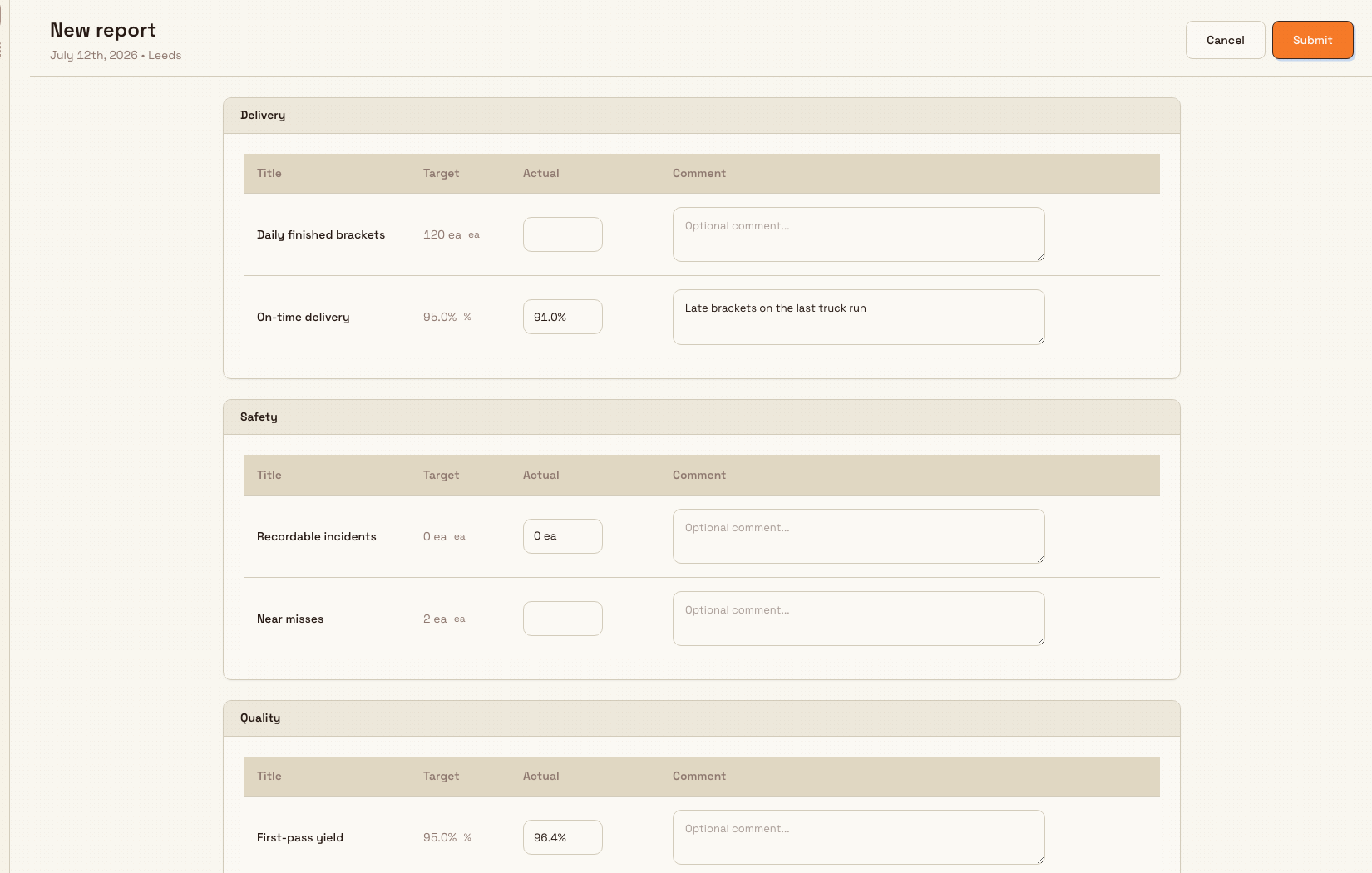
The form opens with the heading New report, the report date, and the site name. KPIs are grouped into cards, one per category, and each card is a small table with these columns:
- Title — the KPI name.
- Target — the goal for that KPI on that date, shown for reference. It is read-only here and displays a dash when no target is set.
- Actual — the value you type in. The field formats the number with the KPI's unit when you click away.
- Comment — an optional note, for example an explanation of a miss.
kpi.reports-02
Submit your changes
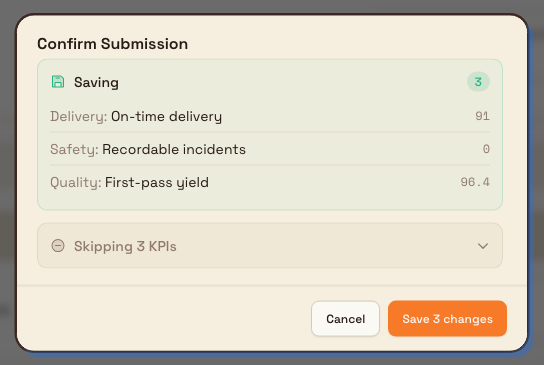
When you have entered or updated the values, select Submit. Before anything is saved, a Confirm Submission dialog summarizes exactly what will happen, split into three groups:
- Saving — the values you entered or changed, with their numbers.
- Clearing — values you emptied that had been recorded before. Clearing removes those recorded results.
- Skipping — KPIs you left blank that had no previous value, listed under a collapsible Skipping n KPIs toggle. Skipped KPIs are left untouched.
Select Save n changes to commit. A confirmation message reads n KPI changes saved. If you try to submit without entering a value or clearing an existing one, Bulk stops you with Please enter a KPI value or clear an existing one.
If you select Cancel while you have unsaved edits, Bulk asks Discard changes? and lets you Keep editing or Discard changes so you do not lose work by accident.
Clearing a value deletes a recorded result
Emptying an Actual field that already had a value puts that KPI in the Clearing group, and submitting removes the recorded result for that site and date. If you only meant to review the report, leave the existing values in place and select Cancel.
kpi.reports-03
Example: reviewing the day at Granite Peak Manufacturing
Granite Peak Manufacturing runs its morning review off its KPIs. The night before, a shift supervisor at the Leeds Fabrication Plant files the daily report: from the plant's Teamboard they select New Report, choose Leeds Fabrication Plant and the previous day, and select Proceed. On the form they enter the manual numbers the shop floor tracks by hand — first pass yield of 96.4 percent under Quality, on-time delivery of 91 percent under Delivery, and zero recordable incidents under Safety — and add a short comment explaining a delivery slip. They select Submit, the Confirm Submission dialog shows Saving 3 and Skipping 2 (two automatic KPIs that are not on the form), and they select Save 3 changes.
The next morning, Dana Winters, who administers the account, wants to understand why on-time delivery dipped. She opens Settings, then KPI, then Management, and selects the On-Time Delivery KPI. On its detail page she confirms the target is set with a ≥ operator, then filters the Audit Log to Target and sees that a manager raised the goal from 90 to 95 percent the previous week — which explains why a strong day now reads as a miss. Because she holds kpi.view, she can trace the change without needing entry rights, and the supervisor who filed the numbers needed only kpi.entry.
Expected result
- From a KPI's detail page, you can confirm how the KPI is measured (unit, aggregation, and operator) and trace every change to its definition, targets, and results in one audit log.
- From the daily report, the site's manual values for a date are saved as a snapshot that records who submitted it. Those values feed the KPI's pass or fail status, its targets comparison, and any dashboards or Teamboards that display it.
Limitations and availability
Reviewing KPI detail and reports is generally available. A few boundaries are worth knowing:
- The report form shows manual KPIs only. KPIs sourced from audits, production, safety incidents, or a formula are calculated automatically and do not appear on the report form. A site with no manual KPIs shows No KPIs available.
- There is no report-history list in the app. You review a past report by opening the New report flow for that site and date, which reloads the recorded values and shows who submitted them. There is no separate page that lists all previously submitted reports.
- The audit log identifies the editor by an account identifier. The Changed By column records who made each change, shown as a user identifier rather than a display name.
- One report per site per date. Submitting again for the same site and date updates the existing snapshot rather than creating a second one.
- All labels, permissions, and behaviors here were verified against the current application code. Live confirmation of the exact on-screen states is completed during the screenshot stage.
Troubleshooting
- "Invalid KPI ID" or "KPI not found" on the detail page. The address does not point to a real KPI. Select Back to KPIs and open the KPI again from the KPI Management list.
- "Please select an entity to view KPI details." No site is in context. Select a site, then reopen the KPI.
- "Entity Required — An entity must be selected to create a report." The report was opened without a site. Start it again from a Teamboard or the create menu so a site is passed in, then select it in the New report dialog.
- "No KPIs available." The chosen site has no manual-entry KPIs. Add one, or check that existing manual KPIs list this site among their allowed sites.
- "Please enter a KPI value or clear an existing one." Submit was selected with nothing to save. Enter at least one Actual value, or empty a previously recorded one, before submitting.
Related
- Create and manage a KPI — define the unit, aggregation, operator, and source that a detail page reflects.
- Set KPI targets — set the goal values that the report shows and that decide pass or fail.
- Manage KPI categories — the categories that group KPIs into cards on the report form.
- Create a Teamboard report — start the daily report from a plant's Teamboard.
- KPIs — everything in the KPIs area.