Respond to a stock alert
Notice, act on, and configure the low, critical, and over-stock alerts Bulk raises for tracked consumable variants at your site.
What a stock alert is
A stock alert is the automatic warning Bulk raises when a tracked material crosses one of its stock limits. In Bulk a consumable is a material used up during production — film, adhesive, welding wire, powder coat — and a variant is the specific, countable form you actually stock (a grade, a colour, a spool size). Bulk keeps a live count of each tracked variant, and when that count moves out of its healthy range it tells the right people so they can act before production is affected.
There are four things a stock alert can tell you:
- Low stock — the quantity has fallen below the variant's Min Stock (its reorder point), but is not yet zero. Time to reorder.
- Critical stock — the variant has run out; the quantity on hand has reached zero. Production of anything that needs this material is at risk.
- Over stock — the quantity is above the variant's Max Stock. You are holding more than you planned, which ties up space and cash.
- Stock recovered — a follow-up notice sent when an item that was low, critical, or over returns to a healthy level, so recipients know the situation is resolved.
You respond to a stock alert whenever one reaches you: confirm what ran short, book in a delivery or correct the count, and let Bulk clear the alert once the balance is back in range.
Where alerts reach you
Bulk surfaces the same alert in more than one place, so you can catch it wherever you happen to be looking:
- In-app notification. Each recipient gets a notification such as "Low stock: Protective Film / D2 Class" with the current quantity and the configured minimum. Opening it takes you straight to the Stock page filtered to that one variant.
- Email. Recipients also receive an email. With Immediate delivery the email arrives as the alert happens; with Digest delivery, several alerts are grouped into a periodic summary email instead.
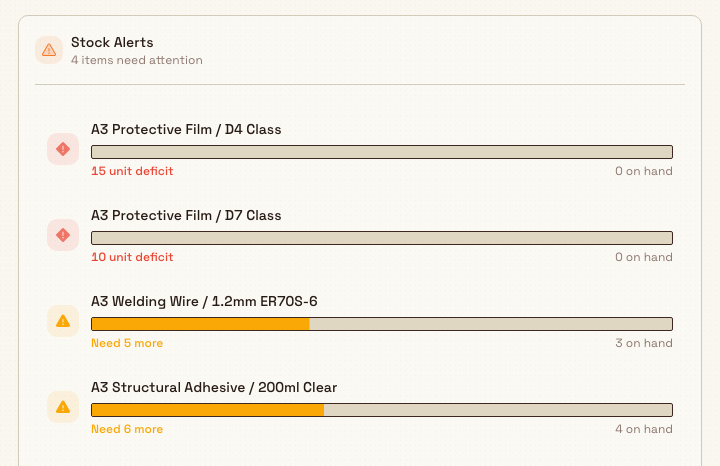
- Stock Alerts panel on Inventory Home. The Stock Alerts panel on the Inventory Home dashboard lists the items that need attention, showing each item's shortfall and quantity on hand, with a View all action when there are more than a few.
- Stock page. On the Stock page every variant carries a colour-coded status badge, and rows are sorted so Critical and Low items rise to the top.
The Home panel lists low and critical items
The Stock Alerts panel on Inventory Home shows items that are Low or Critical — the things at risk of running out. Over stock does not appear in this panel, but it still reaches recipients as an in-app notification and email and is visible on the Stock page, where over-stock rows carry their own Over badge.
inventory.stock-alerts-01
When Bulk raises and clears an alert
Bulk decides a variant's health automatically from its quantity on hand and the reorder points set on the variant:
- Below Min Stock but above zero is Low.
- Zero (or below) is Critical.
- Above Max Stock is Over.
- Anything in range is OK.
An alert fires on the change into Low, Critical, or Over — the moment a stock movement (a receipt, an adjustment, or material consumed by production) pushes the balance across a limit. A movement that leaves the status unchanged does not raise a fresh alert. To avoid flooding recipients, Bulk raises the same alert for the same item at most once per day. When a later movement brings the balance back into range, Bulk marks the alert resolved and sends the Stock recovered notice.
Critical means an item has reached zero
Bulk sets a variant to Critical when its quantity on hand reaches zero, so a critical alert means the item is genuinely out. The Alerts screen also has a Critical threshold percentage field described below; it is stored with your configuration but does not currently change the point at which critical status is triggered. See Limitations for detail.
Before you start
Responding to alerts and configuring them rely on a few things being in place for the entity (the plant or site) you have selected in the entity switcher — alerts always belong to one site.
- To configure alert defaults you need the Manage stock alerts permission (
inventory.stock.alerts). Bulk grants it by default to the Entity admin, Manager, and Master data roles, and to the Super user. The Operator role does not have it. - To receive alerts, a person needs either View stock levels (
inventory.stock.view) or Manage stock alerts in that site. Bulk skips any configured recipient who lacks the permission, so operators — who hold View stock levels by default — can still be notified. - The variant must be set up to trigger alerts. Stock tracking has to be on, and the reorder points have to be set: Min Stock drives Low, Max Stock drives Over, and reaching zero drives Critical. A variant with no Min Stock is never flagged Low; with no Max Stock it is never flagged Over.
If any of these are missing, see Manage consumables and variants to switch on tracking and Configure replenishment thresholds to set Min and Max.
Respond to an alert
When an alert reaches you, work through it in four steps:
- Read the alert. The notification and email name the consumable and variant, the current quantity, and the configured minimum or maximum — enough to know how far short (or over) you are.
- Open the item. Click the in-app notification, or select the item in the Stock Alerts panel on Home, or open the Stock page and find the flagged row. Each route lands you on the affected variant.
- Fix the balance. For a low or critical item, book in a delivery with Receive Stock (or Bulk Receive for several at once), or correct a miscount with a stock adjustment. For an over-stock item, confirm the count is right and move or consume the surplus. See Record a stock movement for how to receive and adjust stock.
- Confirm it clears. Once the movement returns the variant to OK, its status badge flips back, it drops off the Home panel, and recipients receive the Stock recovered notice — your signal that the item is handled.
Configure alert defaults
Set who gets alerted and how from the Alerts screen. Open Inventory in the main navigation and choose Alerts (the URL is /inventory/stock-alerts). The page header reads Stock Alert Configuration.
The screen groups the settings into sections:
- Enable stock alerts — the master switch. Turn it off to stop all low, critical, and over-stock notifications for this site; turn it back on to resume them.
- Delivery — Default frequency. Choose Immediate to send each alert as it happens, or Digest to batch alerts into a periodic summary email. Selecting Digest reveals a Digest time and a Digest timezone field that record when you would like the summary.
- Thresholds — Critical threshold. A percentage field, described on the screen as the percentage of the reorder level that triggers a critical alert.
- Recipients. The list of people who receive alerts for this site. As the screen notes, "These users receive stock alerts unless variant-specific recipients override them."
Make your changes and choose Save Changes. If no recipients are configured anywhere, Bulk falls back to notifying everyone in the site who can view stock alerts, so alerts are never sent to nobody.
Screenshot placeholder
No asset at /docs/en/inventory.stock-alerts/inventory.stock-alerts-02.png yet
- Caption
- The Alerts screen sets the default recipients, delivery frequency, and behaviour for the whole site.
- Framing
- The full Stock Alert Configuration card, from the 'Enable stock alerts' toggle down through the Delivery, Thresholds, and Recipients sections and the Save Changes button.
- Product state
- The Stock Alert Configuration screen for the Leeds Fabrication Plant with alerts enabled, Default frequency set to Immediate, a Critical threshold value, and two or three named recipients selected.
- Setup
- Sign in as an owner or entity admin at Granite Peak Manufacturing, select the Leeds Fabrication Plant entity, open Inventory, then Alerts. Ensure a handful of assignable users exist so the Recipients control shows real names.
inventory.stock-alerts-02
Override alerts for one variant
Some materials deserve different handling from the site default. You can override the recipients and frequency on an individual variant from its Stock settings in Consumables. On the variant form you can:
- Enable stock alerts for that variant, described as sending notifications when stock is low, critical, or over max.
- Set an Alert Frequency of Immediate or Digest for that variant alone.
- Choose Alert Recipients for that variant. As the field notes, "If empty, default stock alert recipients are used" — so a variant with its own recipients overrides the site list, while an empty list inherits it.
Screenshot placeholder
No asset at /docs/en/inventory.stock-alerts/inventory.stock-alerts-03.png yet
- Caption
- A variant can carry its own alert recipients and frequency, overriding the site defaults.
- Framing
- The alert portion of the variant form, showing the 'Enable stock alerts' toggle with its description, the Alert Frequency selector, and the Alert Recipients multi-select with its 'If empty, default stock alert recipients are used' hint.
- Product state
- The variant form open on its stock section with 'Enable stock alerts' turned on, an Alert Frequency selected, and one or two Alert Recipients chosen.
- Setup
- Sign in as an owner or entity admin at Granite Peak Manufacturing, select the Leeds Fabrication Plant entity, open Inventory, then Consumables, open a tracked consumable, and edit a variant that has stock tracking enabled. Scroll to the alert settings.
inventory.stock-alerts-03
Example: keeping the Leeds line supplied
Granite Peak Manufacturing's Leeds Fabrication Plant laminates panels, and its busiest consumable is Protective Film. Dana Winters, the operations lead, opens Inventory, then Alerts, adds the Leeds stores team as Recipients, and leaves Default frequency on Immediate so shortfalls surface straight away. On the fast-moving D2 Class film variant she sets Min Stock to 20 rolls and Max Stock to 200.
Overnight, production laminates a large order and records the film it used. The count slips from 24 rolls to 12 — below the 20-roll minimum — so Bulk flips D2 Class to Low and raises a single alert. Dana arrives to an in-app notification, "Low stock: Protective Film / D2 Class — Current stock is 12. Minimum configured is 20," and a matching email. She clicks through to the Stock page, already filtered to that variant, confirms the shortfall, and uses Receive Stock to book in a fresh delivery of 60 rolls against the purchase-order number. The balance jumps to 72, the status returns to OK, and Dana and the stores team receive a Stock recovered notice — the whole loop closed before the morning shift needs film.
What to expect
- Alerts arrive for each site independently, to the recipients you configured, through in-app notifications and email.
- The same alert for the same item is raised at most once a day, and only when the item's status actually changes.
- Fixing the balance clears the alert automatically and sends a recovery notice; you do not clear alerts by hand.
- Low and critical items appear on the Inventory Home Stock Alerts panel; all alert types appear as notifications, emails, and status badges on the Stock page.
Limitations and availability
Stock alerts are generally available.
- Critical triggers at zero. A variant becomes Critical when its quantity on hand reaches zero. The Critical threshold percentage on the Alerts screen is saved with your configuration but is not currently applied to the point at which critical status is triggered, so setting it does not change when critical alerts fire.
- Digest timing. Choosing Digest batches alerts into periodic summary emails rather than sending each one immediately. The Digest time and Digest timezone fields are recorded with your configuration, but digests are currently flushed on a recurring schedule rather than sent at the exact time you enter.
- One alert per item per day. To prevent noise, Bulk raises the same alert type for the same variant at most once per calendar day, even if the item crosses the threshold repeatedly that day.
- Alerts follow status changes. An alert fires on the transition into Low, Critical, or Over. A movement that keeps the same status does not raise a new alert.
- Recipients must have permission. A configured recipient who lacks View stock levels or Manage stock alerts in the site is skipped, so check permissions if someone expects alerts but does not receive them.
Troubleshooting
- Someone is not receiving alerts. Confirm alerts are switched on for the site on the Alerts screen, that the person is listed under Recipients (or covered by a variant's Alert Recipients), and that their role holds View stock levels or Manage stock alerts — recipients without the permission are skipped.
- No alert fired for an item that ran low. Open the variant and check that Enable stock tracking is on and that Min Stock (for Low) or Max Stock (for Over) is set — without a threshold Bulk cannot flag it. Remember an alert fires only when the status changes, and only once per day.
- The alert did not clear. An alert clears when the variant returns to OK. If it is still showing, the balance is likely still below the minimum (or above the maximum); receive or adjust more stock until it is back in range, and the recovery notice follows.
Related guidance
- Inventory overview — how stock health, alerts, and receiving fit together.
- Review stock levels — read the Stock table and each variant's status badge and history.
- Configure replenishment thresholds — set the Min and Max levels that drive Low, Critical, and Over.
- Record a stock movement — receive, bulk-receive, and adjust stock to clear an alert.
- Manage consumables and variants — switch on stock tracking so a variant is counted and can raise alerts.
- Review production consumption — see how production draws stock down and triggers alerts.
Configure replenishment thresholds
Set the Min Stock and Max Stock levels on a tracked consumable variant so Bulk flags it Low, Critical, or Over and raises stock alerts at the right time.
Review production consumption
See how much stock production has drawn down by opening a consumable's movement timeline in the Inventory Stock area, where Production Usage and Production Reversal entries show quantities and running balances.