Hand planned work to production
How the Scheduling planning board hands work to the shop floor: what a plan does, how production picks it up, and how the board mirrors reality.
Last updated
The planning board in Scheduling is where you lay out when and on which machine each job step should run. This page explains what happens next: how that plan reaches the shop floor, what production has to do to pick it up, and how the board reflects the real state of the work once it starts.
You hand planned work to the floor from Scheduling, and Prioritisation is a separate board for ranking queues, not a replacement for this page.
A job step is one operation on a job (for example, "Laser cut" or "Powder coat"). A machine is one of your assets, the physical equipment a step runs on. When you drag a step onto a machine's timeline, you create a planned run: a proposed placement in time.
How the handoff works
In this release the planning board is an advisory overlay. Placing a step proposes a machine and a start time. It does not reserve the machine, lock the step, or push an assignment into production on its own. Nothing on the board forces the shop floor to run the work in that order.
Work actually reaches production at the moment the shop floor loads the step onto a machine in the Production module. Loading is what puts a job step in front of an operator to run. The handoff happens when production loads and starts the work you planned. Scheduling has no single handoff button.
Two things connect your plan to what production does:
- Grouping carries over. If you group several steps into one planning batch on the same machine at the same start time, then when production loads them onto that machine they load together as one batch, instead of as separate items.
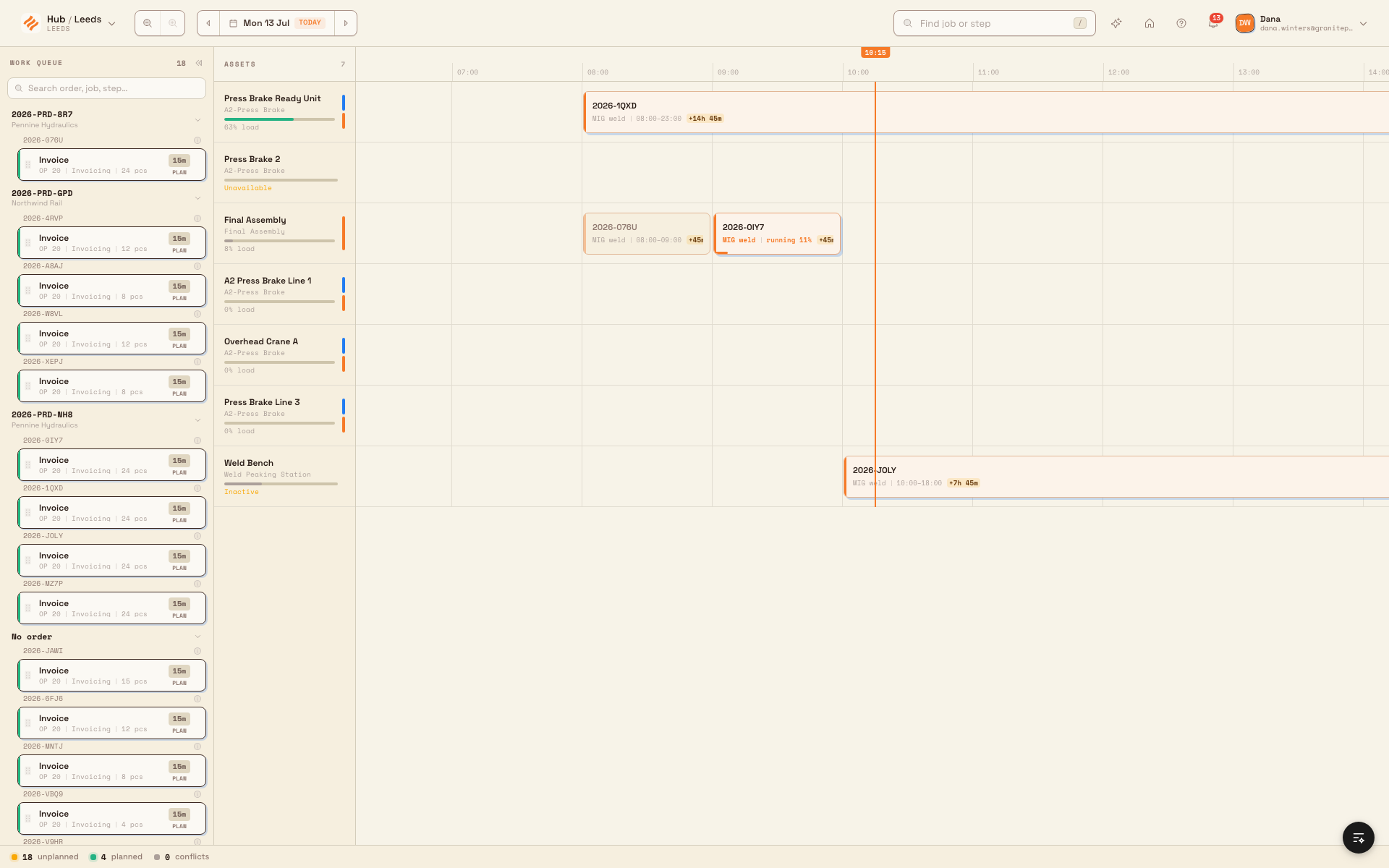
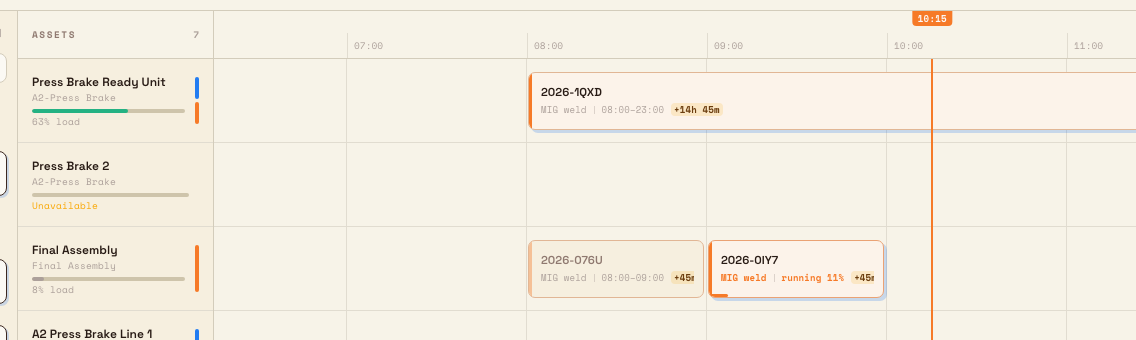
- The board mirrors execution. Each block's state follows the real job step. A block stays planned until an operator starts it, then it shows a running progress fill. Completed steps use a grey Done style.
The plan guides, it does not force
Production can load and run work with or without a plan. A plan makes the intended machine and sequence visible and lets grouped steps load as one batch, but the shop floor is never blocked from loading something different.
Before you start
You need all of the following:
- The Scheduling module enabled for your site. You open the planning board from Scheduling in the left sidebar, which has no Beta badge.
- Permission to open the board. View job planning (
scheduling.view) lets you open the board and see the work queue, machine timelines, and planned runs. Plan jobs (scheduling.plan) lets you place, move, resize, split, merge, and unplan steps. In the default roles, Owner/admin, Manager, and Operator can plan; the shop-floor tablet role can view only. - At least one machine (asset) that is active and not in maintenance or offline, whose asset type allows the step's resource. A resource is the work centre or skill a step needs; a machine can only run a step when its asset type lists that resource. If the board shows "No machines to plan on", add machines in Settings, then allow resources on their asset types.
- Live jobs to plan. Steps on open or in progress jobs can be planned while their state is pending, loaded, or in progress. Completed steps cannot be changed through planning.
Hand a plan to production
You do not push the plan across in one action. You prepare it on the board, and the shop floor draws it down. The typical flow is:
- Place the work. Drag each step from the Work queue onto the right machine and time slot, or use the keyboard placement dialog. See Place or move a job and Use the planning board.
- Group steps that should run together. Drop one placed block onto another at the same machine and start time to form a planning batch. Steps in one planning batch load as a single batch on that machine.
- Let production load it. On the shop floor, an operator loads the planned step (or the whole order) onto the machine. See Load a job and Load a production order. When the step you planned is loaded onto the machine you planned it on, its planning batch is preserved as the real machine batch.
- Watch the board update. As operators start and finish steps, the matching blocks change state on the board in real time, so planners always see the live picture without touching anything.
Gotham Applied Sciences example
Gotham Applied Sciences plans a housing verification order for GCPD Fleet Services. The planner places Assembly on Gotham Fit Bench and schedules Inspection afterwards on a compatible inspection station. If several assembly steps should run together, the planner groups them at the same start time on the same bench.
The operator loads the planned assembly work at the workstation. Steps grouped for that machine load as one machine batch. When an operator starts the step, its block shows running progress. When the step completes, the block uses the grey Done style, allowing the planner to compare the intended sequence with the recorded production state.
What you see after the handoff
- Work queue and lanes. The queue groups available steps under orders and jobs. Machine lanes show the placed runs. The current footer lists keyboard shortcuts; it does not show planned, unplanned, or conflict counters.
- Block states. A placed step uses its planned style until work starts, then shows running progress. Completed blocks use the grey Done style; the timeline does not print a Done label inside the block. In the board's search, a step shows as "In queue", "Running", or "Done" alongside the machine code.
- Completed work locks. Completed steps cannot be moved, resized, split, or returned to the queue. Pending, loaded, and in-progress steps remain eligible for planning changes. Coordinate changes to running work with the floor because changing the plan does not unload or move the actual production work.
Feature state and limitations
These limits still apply. The behaviour below matches the current build. The sidebar does not mark Scheduling as Beta, and the board still does not book the shop floor for you.
- Advisory overlay only. Planning placements never change a job step's assigned machine or its production loading records on their own. There is no "send to production", "release", or "commit plan" button in Scheduling. The handoff happens when production loads the work.
- Overlaps are allowed, not blocked. You can place two steps on the same machine at the same time. The board flags the overlap on the blocks but does not stop you. The planner resolves the conflict.
- Grouping carry-over is per machine and start. A planning batch only forms for steps on the same machine at the same start time, and it only loads as one batch when production loads those steps onto that same machine. Loading the same step onto a different machine does not inherit the planned grouping.
- The board loads a time window. Placed runs are loaded for the visible window, while the work queue loads further pages as you scroll. A completed block can remain visible until cleanup removes its old planning run.
Troubleshooting
- A block will not move, resize, or return to the queue. The step may be completed in production, which prevents planning changes. Attempting to plan it returns "This step can no longer be planned". Check its actual state and coordinate any production change on the shop floor.
- A step will not drop onto a machine ("This machine cannot run this step"). The machine's asset type does not list the step's resource. Pick a compatible machine, or update the asset type's allowed resources in Settings. See Review capacity and resource context.
- A machine refuses new work ("This machine is unavailable right now"). The machine is in maintenance or offline. Bring it back online or plan onto another compatible machine.
- A step vanished from the board ("The job for this step is not active"). Its job is no longer open or in progress, so new planning changes are refused. Already placed completed blocks can remain visible until cleanup removes their old runs.
- Production loaded the steps but they did not batch together. They were only grouped if they sat in one planning batch on the same machine and were loaded onto that same machine. Confirm the batch on the board before the shop floor loads, and load onto the planned machine.
Related guidance
- Use the planning board, the board layout, work queue, and day window.
- Place or move a job, placing, moving, splitting, and batching steps.
- Review capacity and resource context, machine and resource compatibility and load.
- Load a job and Load a production order, how the shop floor picks up planned work.
- Unload production work, reversing a load on the shop floor.
- Production overview, the wider production execution workflow.
- Prioritise work on the board when you want to rank queues. That board does not replace this page.
Review capacity and resource context
Read the planning board's asset column and Display controls to see each machine's daily load, live status, and compatible work centres.
Inventory
Track consumable stock across a plant in Bulk — receive and adjust quantities, set reorder points, watch stock health, and act on low-stock alerts.