Beta
Scheduling
Plan production job steps onto machine timelines in the Scheduling job planning board, then move, resize, split, and balance work before it reaches the shop floor.
Scheduling is where you plan production work before it starts. The module has a single screen, the job planning board, which you reach from the left sidebar under Scheduling → Planning. On the board you take the steps of your open production jobs and place them onto a timeline for each machine, so you can see what runs where, in what order, and whether anything overlaps. Everything you see and change is for the site you are currently working in.
Bulk is a Manufacturing Execution System (MES): it tracks the jobs your plant makes and the routing — the ordered list of steps — that each job follows. Scheduling adds a planning layer on top of that production data. A few terms are used throughout this section:
- A job step is one step of a production job's routing (for example, a laser-cut or a weld).
- A work centre (also called a resource) is the capability a step needs. A step can only be planned on a machine whose asset type allows that work centre.
- A run is a slice of a job step placed on a machine's timeline. Placing a step creates a run; splitting a step creates several runs that together cover the step's quantity.
When to use scheduling
Open the planning board when you want to:
- Lay out the coming days of work across your machines instead of deciding step by step on the floor.
- Balance load — move a run to a quieter machine, or split a long step across two machines to finish sooner.
- Resequence work to hit a due date.
- Spot overlaps (called conflicts) before they cause a clash on a real machine.
- Give everyone with access a shared, live picture of the plan, since the board updates in real time.
Before you start
Three things need to be in place before the board is useful.
- Permission. You need View job planning to open the board and read the work queue, machine timelines, and planned runs. You need Plan jobs to place, move, resize, split, merge, or unplan work. By default the Super user, Entity admin, Manager, and Operator roles have both, so most planners can change the board straight away. The Tablet user role can view the board but not plan on it. Both permissions apply only to the site you have selected.
- Machines and work centres. At least one active machine (asset) must exist, and its asset type must allow the work centres your steps use. If no machine can host any work, the board shows the message "No machines to plan on" with a shortcut to open asset settings. See Assets and layouts and Resources to set these up.
- Work to plan. The board's work queue is fed by production jobs whose status is open or in progress. If nothing is open or in progress, the queue is clear and there is nothing to place. See Orders and jobs for how jobs reach that state.
View-only access
If you have View job planning but not Plan jobs, the board opens normally but is read-only: you can browse the queue and timelines, but the drag handles and the right-click planning menu are switched off. Ask a site administrator to grant Plan jobs if you need to change the schedule.
What is on the board
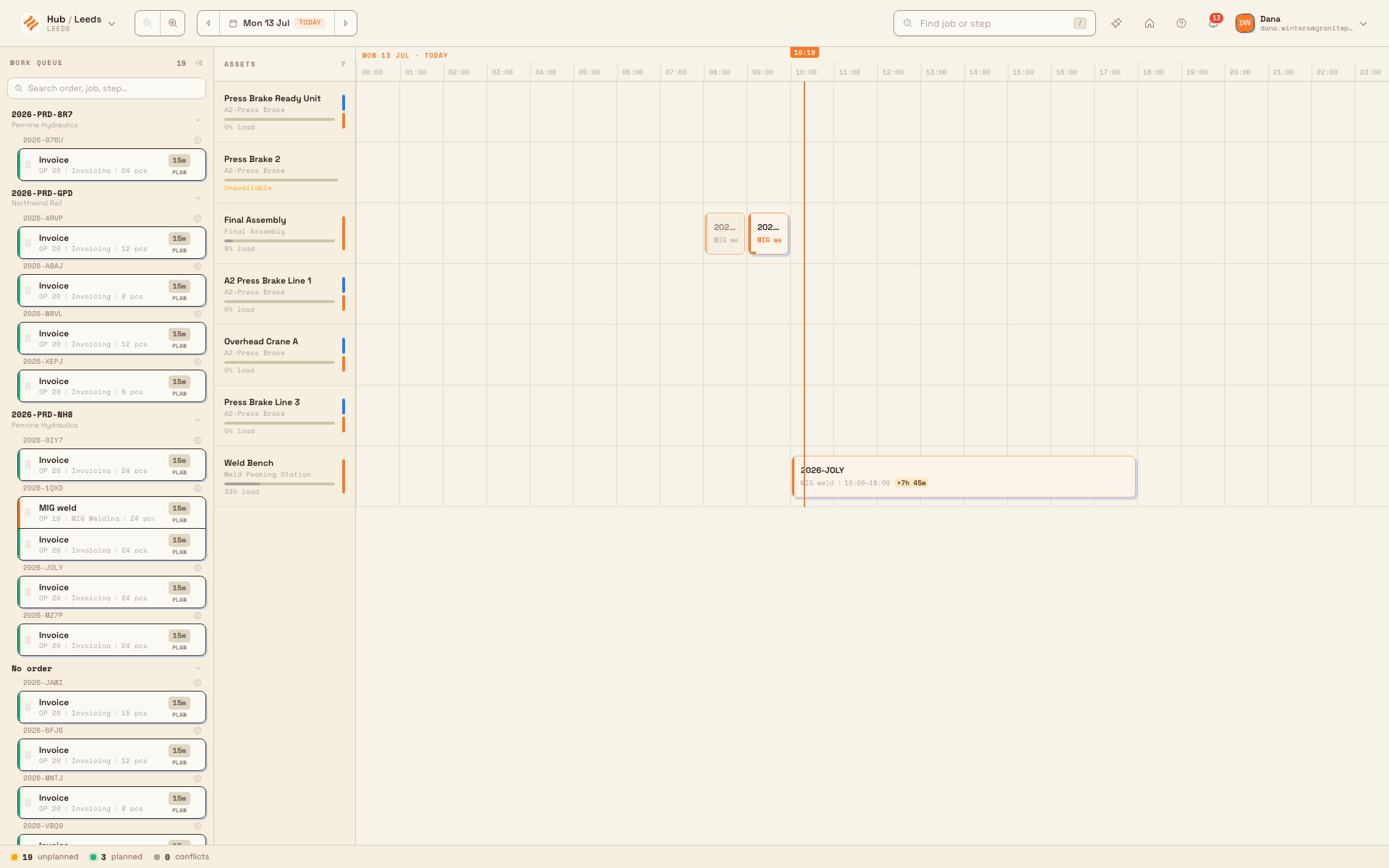
The planning board fills the whole screen, replacing the usual sidebar and header so it can own the space.
scheduling.overview-01
- Work queue (left). A collapsible panel that lists the work still to plan, grouped Order → Job → Steps. A count next to the "Work queue" heading shows how many steps are still unplanned, and a search box ("Search order, job, step…") filters the tree. Each step card shows its work centre, quantity, and an estimated duration.
- Machine timelines (right). One row per machine. Planned runs appear as blocks positioned by their start time and length; a colour legend links each block colour to its work centre. A run that is under way shows a progress fill.
- Header controls. Zoom out and zoom in buttons, a day chip with Previous day, Today, and Next day, a Find job or step box (keyboard shortcut
/), and an Auto-plan button. - Footer status strip. Live counts of unplanned steps, planned runs, and conflicts, plus a warning if the board had to truncate the number of runs it shows.
What you can do
The overview links out to a focused guide for each task. Each one uses the exact controls above.
scheduling.overview-02
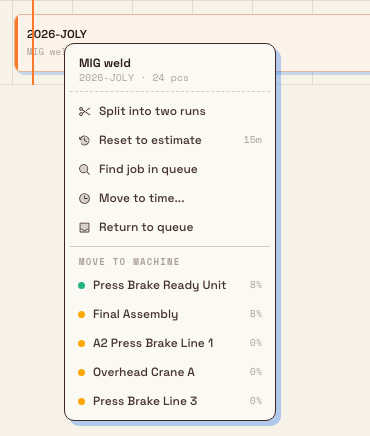
- Use the planning board — read the queue and timelines, split a long step into two runs, and merge split runs back together.
- Place or move a job — drag a step from the queue onto a machine, move a run to another time or machine, resize its duration, or return it to the queue. You can also use the keyboard: the "Plan queue step" dialog asks for a Machine, Day, Start time, and Duration.
- Set a planning time window — choose how many days the board shows (it starts at today and can span up to 60 days), page to earlier or later dates, and zoom the timeline in or out.
- Review capacity and resource context — read each machine's load, understand which machines a step is allowed on, and see where a step's estimated duration comes from (recent history for the part or step, or a fallback estimate). You can override a run's duration and reset it back to the estimate.
- Hand planned work to production — understand how the plan relates to what operators actually run in the Production module.
Example: planning a morning at Granite Peak
A planner at Granite Peak Manufacturing's Leeds Fabrication Plant starts the week on the job planning board. The work queue lists open jobs in due-date order — near the top is order 2026-4101 for the customer Northwind Rail, whose job has a laser-cutting step and a welding step.
The planner drags the laser-cutting step from the queue onto the Laser 1 machine row at 08:00. A run appears with a duration estimated from the part's recent history. The welding step is long, so the planner splits it into two runs and places one on Weld Bay A and the other on Weld Bay B to finish before the Thursday due date, watching the conflict count in the footer stay at zero. By mid-morning the queue's unplanned count has dropped and the timelines show a balanced picture of the week for the Leeds site — visible in real time to every colleague who has view access.
What you will see
Once you place work, planned runs sit on their machine rows for the selected site, the footer reflects the current unplanned, planned, and conflict counts, and the plan is immediately visible to everyone with view access. Because the board is a planning layer, placing a run records your intended schedule; it does not itself book time against a job or load a machine on the floor. Operators still start and record work in the Production module.
Dates and time zones
The board's days, today marker, due dates, and planned local times use the selected site's timezone. A planner viewing the board from another timezone sees the same plant schedule and calendar dates. Weekly planning still uses the organization's shared week-start rule.
Feature state and limitations
Scheduling is a beta feature, shown with a "Beta" badge in the sidebar. Keep the following in mind.
The schedule is a plan, not a floor booking
In this version the board is a planning overlay. Placing, moving, or splitting a run records the plan only — it does not change a job's assigned machine or the live machine loading that operators see in Production. Treat the board as the shared plan, and confirm actual work in the Production module.
- Automatic planning is not available yet. The header has an Auto-plan button, but it is not functional in this version; selecting it only shows a short notice. All planning today is done by hand.
- Board size limits. The board shows up to a fixed number of runs in the current window; if there are more, the footer shows "board truncated — not all runs shown" and you should narrow the day window. The queue lists open and in-progress jobs up to a cap, in due-date order. Runs are at least 15 minutes long and snap to 15-minute steps.
- Site scope. The board only shows and changes work for the site you have selected. To plan another site, switch sites first.
Troubleshooting
- "No machines to plan on." The board shows this empty state when no machine can host any work. Add machines and allow the right work centres on their asset types, then reopen the board. The empty state's "Open asset settings" button takes you straight to asset settings.
- A step will not go onto any machine. In the keyboard planning dialog you may see "No compatible machines are available." This means the step's work centre is not allowed on any active machine's asset type. Allow that work centre on a suitable machine's asset type and try again.
- The board says it is truncated. "board truncated — not all runs shown" means the window holds more runs than the board can display at once. Reduce the number of days in view so the runs you care about are shown.
- You cannot drag or right-click to plan. The board is read-only for you because you have View job planning but not Plan jobs. Ask a site administrator to grant Plan jobs.
- The conflict count is above zero. Two runs overlap on the same machine. Conflicting runs are highlighted on the timelines; move or resize one of the overlapping runs until the count returns to zero.
Related guidance
Respond to a blocking pre-use check
Clear a workstation that Bulk has blocked from production by completing its compulsory pre-use check, or by requesting a time-limited supervisor override.
Use the planning board
Orient yourself on the Scheduling planning board — the drag-and-drop view where you plan job steps onto machines across a multi-day timeline — and learn how to open, read, and work it.