Run a custom audit
Run a custom audit — a checklist your site defines for a routine the standard audit families don't cover — from the shared start flow, then review its pass or fail result.
A custom audit is a structured checklist your site defines for a routine that does not fit any of Bulk's other audit families. An "audit" in Bulk is a structured inspection: someone opens a fixed list of questions, records a result for each one, attaches evidence where a question calls for it, and submits. Bulk then grades the audit, files a timestamped report you can reopen or export, and — if the template was set up that way — can notify people or open a follow-up task automatically.
Custom is one of six audit families in Bulk, alongside Safety, Quality, Maintenance, Pre-Use, and 5S. The other five each carry a fixed meaning. Custom is the flexible, catch-all family: use it when your recurring check is a real, repeatable inspection but does not match any of those five. Typical custom audits are a GEMBA walk (a structured shop-floor walk), an end-of-shift handover, a daily SQDCP stand-up checklist, or a material requisition form.
This article covers running a custom audit that has already been set up for you. Building the checklist, the areas, and the schedule is a one-time setup task done by an administrator — see the related links at the end.
What makes a custom audit different
A custom audit runs through exactly the same engine as the other non-5S families, so the mechanics — question types, automatic scoring, and the pass or fail result — are identical to a safety or quality audit. Three things are worth knowing before you run one:
- Its meaning comes entirely from your template. Custom is a container, not a preset. A GEMBA walk and a shift handover are both "custom audits"; what each one checks is whatever your site's template author put in the checklist.
- The subject can be an area or an asset. A custom template is set up as either standalone (it runs against an area of your plant) or asset-bound (it runs against a specific machine). The Custom Audits report list labels each report's subject as Asset or Area so you can tell them apart.
- It grades pass or fail like the standard families. On submission Bulk returns one overall result — Passed, Failed, or Passed with Issues — using the same scoring rules as a safety, quality, maintenance, or pre-use audit.
Before you start
Running a custom audit depends on two things: the right permission, and a custom audit that has been scheduled onto an area you cover.
Permissions. Two permissions control the run-and-review experience:
- Run audits (internally
audits.execute) — start, fill in, and submit an audit. - View audits (internally
audits.view) — open completed and in-progress audit reports.
Among the default roles, both are carried by Super user, Entity admin, Manager, Operator, Tablet user, and Invoicing. Without Run audits, the Audits area is read-only for you.
Setup that must already exist. A custom audit can only be run once an administrator or manager has, in Settings → Audits:
- Built and published a Custom-type audit template — the checklist of questions.
- Created at least one audit area — the place the audit applies to.
- Added a schedule that links the published template to that area at a cadence (One-Time, Daily, Weekly, or Monthly).
Creating and publishing templates needs the audits.create, audits.update, and audits.publish permissions, which the Super user, Entity admin, and Manager roles carry.
A faster way to build a custom template
Setup does not have to start from a blank checklist. In Settings → Audits → Templates, Browse Templates opens a library of ready-made checklists that includes several custom ones — for example GEMBA Walk, Shift Handover Report, SQDCP Daily Meeting Checklist, and Material Requisition Form. Choosing one creates an editable draft your administrator can adjust and publish, rather than building every question by hand.
Find and open a custom audit
There are two ways in.
From the Audits inbox. Open /audits for every audit due to you, or /audits/custom for the custom-filtered inbox. The inbox groups work into Overdue, Due today, In progress, and Completed (last 7 days). Click a due or overdue custom row to begin; click an In progress row to resume exactly where it was left off.
From "Start a new audit". Use the start flow when you want to pick an audit deliberately rather than from your due list. It is a three-step picker:
- Select audit type — choose Custom (its row reads "Custom audit templates."). Families with no eligible audits in your assigned areas are greyed out with a "No audits" label.
- Select audit — pick the published template you want to run. Each row shows the template code and its cadence.
- Select area — pick where you are running it. Only areas the template is scheduled into appear. The checklist opens as soon as you choose the area.
You can jump straight to this flow with Custom pre-selected at /audits/custom/start.
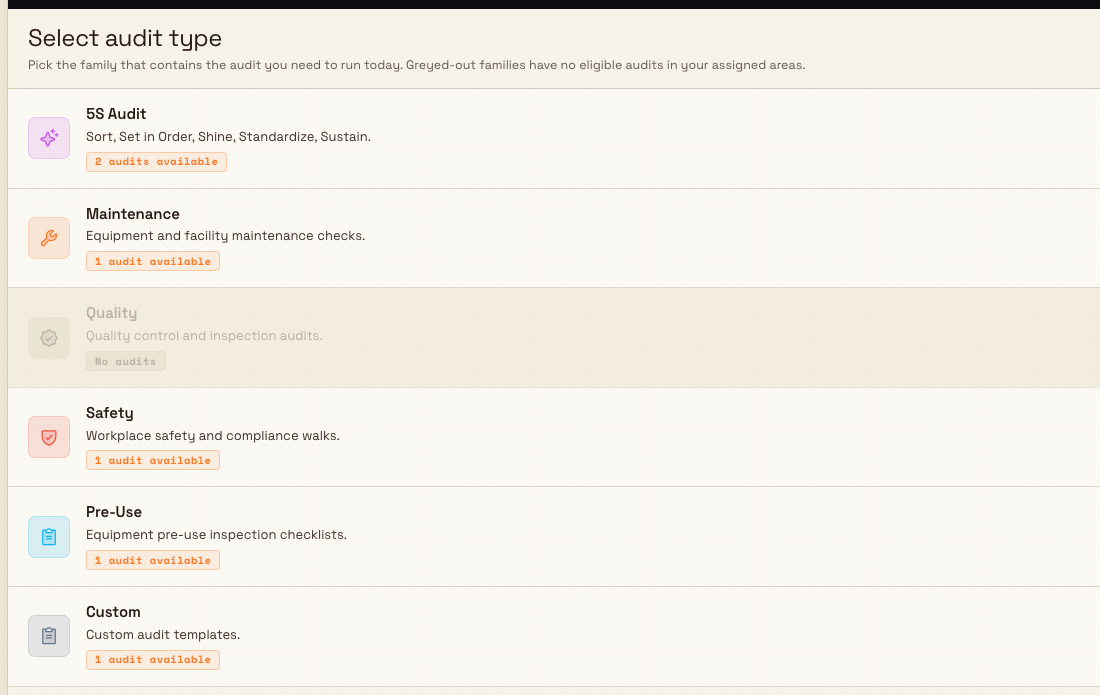
audits.custom-01
Work through the checklist
The audit opens as a single-question-per-page wizard with a checklist sidebar on the left, so you always know how far through you are. Answering questions works the same way for every audit family:
- Answer each question. Question types include Pass / Fail, Yes / No, a numeric reading, single- or multi-select, free text, a date or time, a photo, or a signature. Your answers save automatically as you go — there is no separate save button.
- Attach evidence. Where a question asks for a photo, add one directly on that question; it is stored with the response and appears in the finished report.
- Move around. Use Next and Previous to step through, or click any question in the sidebar to jump to it. A required question must be answered before the wizard lets you move past it.
- Stop safely if needed. Cancel audit discards the in-progress attempt after a confirmation. If you simply leave the page, the audit stays In progress in the inbox for you or a teammate to resume.
For the full detail of each control, see Complete an audit response and Attach audit evidence.
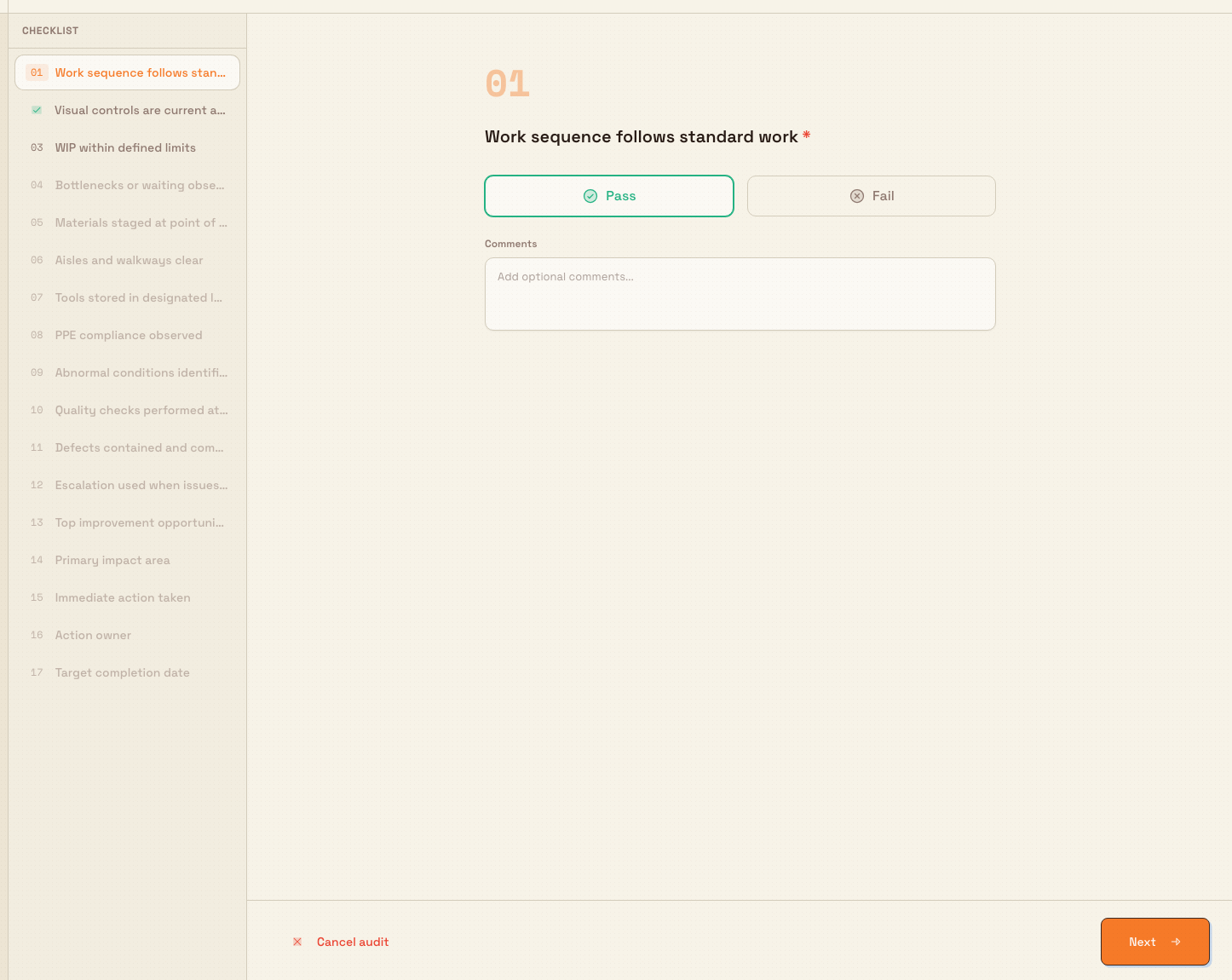
audits.custom-02
Submit and get a result
When every required question is answered, choose Submit. A confirmation summarises how many checks passed and failed and warns that the action cannot be undone. Confirm to finish.
On submission Bulk grades the audit and returns one overall result:
- Passed — everything met the standard.
- Failed — the audit did not meet the standard.
- Passed with Issues — it passed overall but at least one item needs attention.
You are returned to the Audits inbox with a confirmation of the result.
Automatic follow-up (only if configured). A template author can attach completion triggers to a custom template so that submitting an audit automatically notifies chosen people or creates a follow-up task in a project. These are off unless someone set them up on the template, so do not assume a failing audit will alert anyone by itself.
The 'block the asset' action no longer stops production
An older "block the asset" completion action still appears in template configuration, but it is deprecated: Bulk skips it when a custom audit is submitted. Completing or failing a custom audit records the result and can notify people or raise a task, but it does not itself halt an asset or line.
Example: a weekly GEMBA walk at Granite Peak
Granite Peak Manufacturing runs a weekly GEMBA Walk — a structured shop-floor walk to observe processes and spot waste — as a custom audit on the Fabrication Cell area at its Leeds Fabrication Plant. The walk is not a safety walk, a quality inspection, a maintenance check, a pre-use check, or a 5S score, so the plant built it as a Custom template from the library rather than forcing it into another family.
Every Monday the walk appears under Due today in the continuous-improvement lead's Audits inbox. He opens it and works through the sections — Flow & Standard Work and 5S & Safety — marking each item Pass / Fail or Yes / No and photographing anything worth following up. On the "Bottlenecks or waiting observed" item he answers Yes and adds a note about a staging delay at the press. He submits, and Bulk records the result as Passed with Issues.
Because the template's author added a "create a task" completion trigger, submitting the walk also opens a follow-up task in the plant's improvement project for the staging delay — no one had to raise it by hand. The completed walk stays in the Custom Audits list as that week's record.
Review the completed report
Completed and in-progress custom audits live under Audits → Custom Audits (/audits/views/custom). The list shows Template, Subject (the area or asset audited, labelled Area or Asset), Status, Result, Completed By, and Completed At, and you can filter by status or result and search across them.
Open any row to see the full report: the numeric audit score, the passed and failed counts, every question with its recorded answer and any attached photos, and who completed it and when. Export Report produces a PDF you can share outside Bulk or keep for your records.
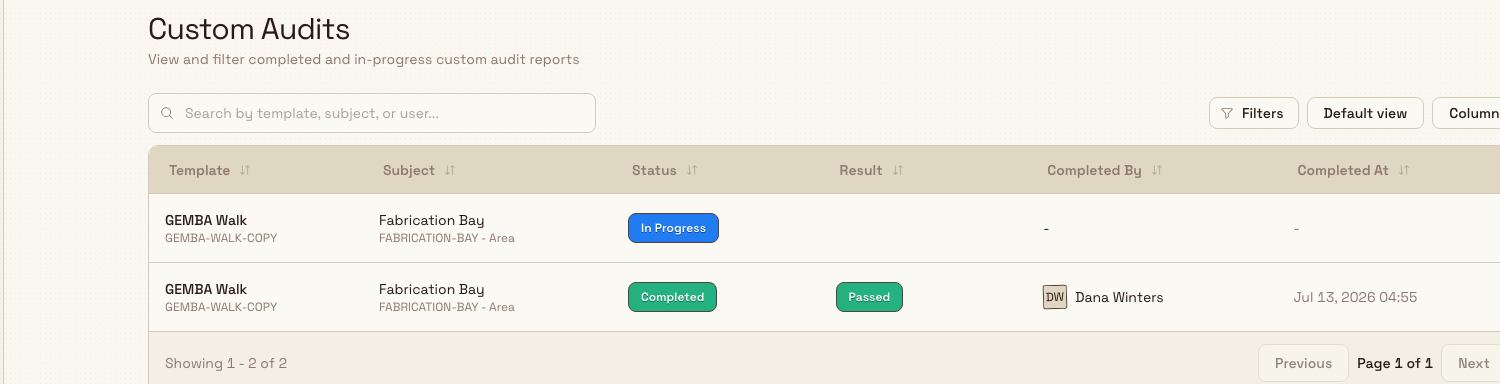
audits.custom-03
Feature state and limitations
Custom audits are generally available — a shipped part of the Audits module, not a beta or preview feature.
Keep these boundaries in mind:
- You can only run what has been scheduled. If no published custom template is scheduled onto an area you cover, the Custom family is unavailable in the start flow and nothing appears in your inbox. This is expected, not an error.
- Custom is a container, not a preset. The checklist's meaning comes entirely from how your site built the template — Bulk provides the shell and the scoring, not the questions.
- Submitting is final. The confirmation states the action cannot be undone; treat submission as sign-off rather than a draft save.
- Follow-up automation is opt-in. Notifications and follow-up tasks only happen when a template author configured them; the "block the asset" action is deprecated and has no effect.
- Reports are read at the report screen. Editing responses after submission is not part of this flow — a correction means running the audit again.
Troubleshooting
- The Custom family is greyed out, or "No audits" shows. No published custom template is scheduled into your areas. Ask an administrator or manager to publish a Custom-type template and add a schedule for it in Settings → Audits.
- You cannot submit — a required item is flagged. A required question is still blank. Use the checklist sidebar to jump to any unanswered item; the wizard blocks forward navigation on required questions until they are answered.
- An audit you started earlier is not in the Custom Audits list. It is under In progress in the Audits inbox, not yet in the completed list. Open it there to resume; it reopens where you left off rather than starting over.
- You expected an alert or task after submitting and none appeared. Completion triggers are per-template and opt-in. Confirm with the template's author whether a notify or create-task trigger is configured.
- You are not sure whether a check belongs in Custom. If the routine matches Safety, Quality, Maintenance, Pre-Use, or 5S, run it as that family so it lands in the right review view and dashboards. Reach for Custom only when none of the five fit.
Related guidance
- Start an audit — the shared start flow for every audit family.
- Complete an audit response — answering individual checklist questions.
- Attach audit evidence — adding photos and files to a response.
- Override an audit response — supervisor overrides where they apply.
- Review audit results — filtering, opening, and exporting completed reports.
- Audits overview — how the whole Audits module fits together.
Run a maintenance audit
Start, complete, and submit a scheduled maintenance audit against a plant asset or area, then review its pass or fail result.
Run a 5S audit
Run a scheduled 5S workplace-organization audit, score each of the five pillars, and track how your areas hold their standard on the 5S dashboard.