Run a pre-use audit
Carry out a pre-use safety check on a machine before it runs — start it from the workstation or the Audits area, work through the checklist, and submit a pass or fail that clears or blocks the asset.
A pre-use audit is a short safety inspection you complete against a piece of equipment before it is used — for example checking a forklift's forks, tyres, brakes, and horn at the start of a shift. Bulk groups audits into six families, and this one is called Pre-Use ("Equipment pre-use inspection checklists"). The record a completed run produces is called a pre-use check, so "pre-use audit" and "pre-use check" mean the same thing: the checklist you run, and the result it files against the machine.
What makes pre-use audits different from the other audit families is that they are usually tied to a specific asset — any piece of equipment you track, such as a press brake, a forklift, or an overhead crane — and a required pre-use check can block that asset from running until it is completed and passes. That is why an operator normally runs one at the workstation, on a tablet, before starting the machine.
This article covers carrying out the check. Building the checklist and deciding which machines it applies to is a one-time setup task an administrator does in Settings (see the related links at the end).
Before you start
You need the Run audits permission (named audits.execute internally) for the site you are working in. Among the default roles it is granted to Super user, Entity admin, Manager, Operator, Tablet user, and Invoicing — so the standard shop-floor and tablet roles can run checks out of the box. Without it, the audits area is read-only for you.
A pre-use audit can only be run once an administrator has set it up. Depending on how they configured it, the check reaches you in one of two ways:
- As a check on a specific machine. The template is tied to an asset (or an asset type, so every machine of that kind inherits it). You run it at the workstation for that asset.
- As a scheduled audit on an area. The template is put on a schedule against a work area you cover, and it appears in the Audits area alongside your other due audits.
Nothing to run yet?
If no pre-use template has been set up for your machine or your areas, the Pre-Use family shows a "No audits" label in the start picker and no checks appear on your workstation. That is expected — ask an administrator to publish a pre-use template and assign or schedule it, or confirm you are signed in to the correct site.
Run a check at the workstation
This is the most common path. When you open the production home for an asset, Bulk loads that machine's asset readiness — the state of its pre-use checks — and lists any check that is Due, Expired, or In Progress.
- Open the workstation (production home) for the machine you are about to use.
- Find the pre-use check in the asset's checks list. If a required check is due, the workstation shows a blocking state: the asset cannot start production until the check is completed and passes.
- Select the check. A Not Started or due check opens a fresh run; an In Progress check resumes exactly where it was left off, so a check can be handed between operators mid-shift.
The checklist opens in the audit execution screen described below.

audits.pre-use-01
Run a check from the Audits area
If your administrator scheduled the pre-use template against an area rather than a single machine, run it from the Audits area instead.
- Open the Audits landing page at
/audits, or choose Start a new audit. - Select audit type — choose Pre-Use ("Equipment pre-use inspection checklists"). Families with no eligible audits are greyed out.
- Select audit — pick the template you need. Each row shows its cadence (Daily, Weekly, Monthly, or One-Time) and how many areas it covers.
- Select area — pick where you are running it. Only areas the template is scheduled in appear, and the checklist opens as soon as you choose one, at
/audits/execute/<audit-id>.
Due and overdue pre-use audits scheduled to your areas also appear in the /audits inbox under Overdue and Due today, so you can open one directly instead of starting from scratch.
Work through the checklist
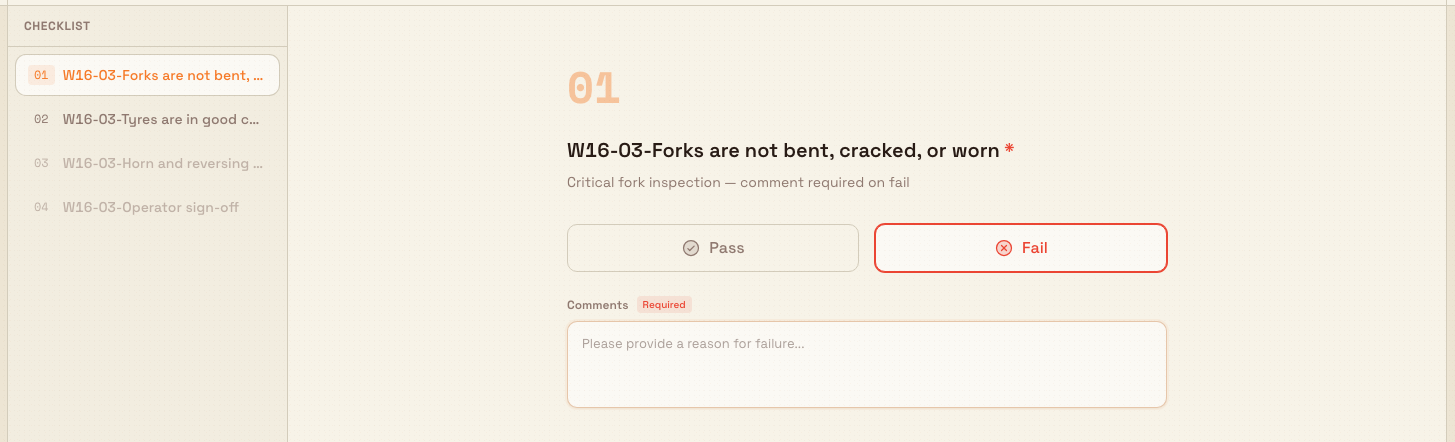
The check opens as a wizard that shows one question per page, with a Checklist panel you can use to jump to any question you have already answered. Each item is one of several input types — pass/fail, yes/no, a numeric reading, free text, a single or multi-select, a photo, a signature, a date, or a time — so a single pre-use check can mix a brakes pass/fail with a tyre-pressure reading and a photo of a damaged guard.
A few rules govern progress:
- Required items must be answered before you can advance past them or submit. A required item is marked with a red asterisk.
- A failed check may demand evidence. If you mark a pass/fail or yes/no item as failing and the template requires it, Bulk blocks Next and shows the reason — for example "Comment required for failed items" or "Photo required for failed items" — until you add the note or photo.
- Your answers save as you go. There is no separate save button; each answer is stored the moment you set it, so you can leave a check part-finished and resume it later.
Move through the items with Next and step back with Previous. For the full detail of each answer type and the comment-and-photo rules, see Complete an audit response.
audits.pre-use-02
Submit the result
On the last item the primary button becomes Submit. Submitting opens a Submit Audit confirmation that summarises how many checks passed and failed and warns that the action cannot be undone. Confirm with Submit.
Bulk then grades the check. Pre-use audits use pass/fail grading: the overall result is Pass, Fail, or Pass with Issues. A critical item that fails will fail the whole check on its own — so a single critical safety item, such as a cracked fork, produces an overall Fail even if everything else passed.
Submitting is final
Submitting a check is irreversible — you cannot reopen and edit your own answers afterward. If a submitted result is wrong, an administrator with the Override audits permission must override it. Choosing Cancel audit while running discards every answer you have entered; use Keep Working on the cancel prompt if you did not mean to.
What a pass or fail means for the asset
For an asset-bound pre-use check, the result decides whether the machine can run:
- Pass clears the asset. If the passed check was the only thing blocking it, the machine moves to Ready and production can start.
- Fail on a required check keeps the asset Blocked. Bulk stops operators from starting production on that machine until a passing check is recorded, or a supervisor grants a temporary override at the workstation.
A failed safety check means the machine is not cleared
A blocked asset has failed a safety check for a reason. Do not run it because production is behind. If work genuinely cannot wait, a supervisor with the override permission can authorise a time-limited exception — recorded with a reason and an expiry — but the underlying check still needs to be completed and passed.
Checks that are only Recommended or Optional do not block the asset on their own; a required check is the one that gates production.
Example: a forklift pre-use check at Granite Peak
Granite Peak Manufacturing runs a daily Forklift Pre-Use Check (code FORKLIFT-PRE) at its Leeds Fabrication Plant. The template is tied to the plant's forklifts, so it appears as a required daily check on each truck.
At the start of the early shift, Marcus — a Tablet user, so his role includes Run audits — opens the workstation for forklift FLT-03. Because the daily check has not been done yet, the workstation shows the truck as blocked and lists the Forklift Pre-Use Check as Due. He taps it and works through the checklist:
- Forks are not bent, cracked, or worn — a critical pass/fail. There is a hairline crack near the heel of the left fork, so he marks it a fail. The item requires a comment on failure, so Bulk holds Next until he types "Hairline crack, left fork heel" and photographs it.
- Tyres are in good condition — pass.
- Horn and reversing alarm work — pass.
- Operator sign-off — he signs the item.
On the last page he presses Submit, the confirmation shows one check failed, and he confirms. Because the cracked fork is a critical item, the overall result is Fail, and FLT-03 stays Blocked. The forklift cannot be started until it is repaired and a fresh check passes, so Marcus takes a different truck and reports the fault. If the truck were genuinely needed, a supervisor could grant a short override at the workstation — but the crack still has to be fixed and re-checked.
Where the result goes
- The completed check is filed under Pre-Use Checks in the sidebar (the results list at
/audits/views/pre-use-checks), where every recorded check is listed with its Status and Result and can be filtered. - Opening a check shows each item's answer and any attached photos or signatures — the full record of what was inspected and when.
- The machine's readiness updates immediately, and the plant-wide picture is visible on the Asset Readiness page.
- The schedule advances: a daily check reappears the next day, a weekly one the following week.
Limitations and feature state
- Availability. Pre-use audits are a generally available feature; nothing here is in beta.
- Setup is a prerequisite, not part of this task. You cannot run a pre-use check until an administrator has published a pre-use template and either tied it to your machine or scheduled it into an area you cover. That setup needs the Create audits and Publish audits permissions.
- Blocking depends on the requirement level. Only a required pre-use check blocks an asset. Recommended and optional checks are prompted or available but do not stop production on their own.
- Submissions are final. There is no self-service edit after submit — corrections go through an administrator override.
- Grading is pass/fail. Pre-use checks resolve to Pass, Fail, or Pass with Issues, with a critical failure failing the whole check. The weighted scoring used by 5S audits does not apply here.
Troubleshooting
- Pre-Use is greyed out, or no check appears on the machine. No published pre-use template is tied to that asset or scheduled into an area you cover. Ask an administrator to set one up, or confirm you are in the right site.
- Next or Submit is disabled. A required item is unanswered, or a failed check still needs its required comment or photo. The wizard shows the reason; use the Checklist panel to jump to the blocked item.
- The machine is still blocked after you submitted. The check failed, or a different required check is still due. Open the asset's checks to see which one is the reason, then complete and pass it — or ask a supervisor to override at the workstation.
- You submitted with a mistake. You cannot reopen your own submission. Ask an administrator with the Override audits permission to override the result.
- You need to stop without a result. Use Cancel audit; be aware it discards every answer. To pause instead, simply leave — an in-progress check is saved and reappears so you can resume it.
Related guidance
Run a 5S audit
Run a scheduled 5S workplace-organization audit, score each of the five pillars, and track how your areas hold their standard on the 5S dashboard.
Review audit results
Where completed and in-progress audit reports collect in Bulk — the per-type Audits review views — and how to filter, open, and export a report.