Select an asset or workstation
Pick the asset or workstation you'll operate to enter Bulk's production floor, search, filter, read live status, and open the right operator screen.
Last updated
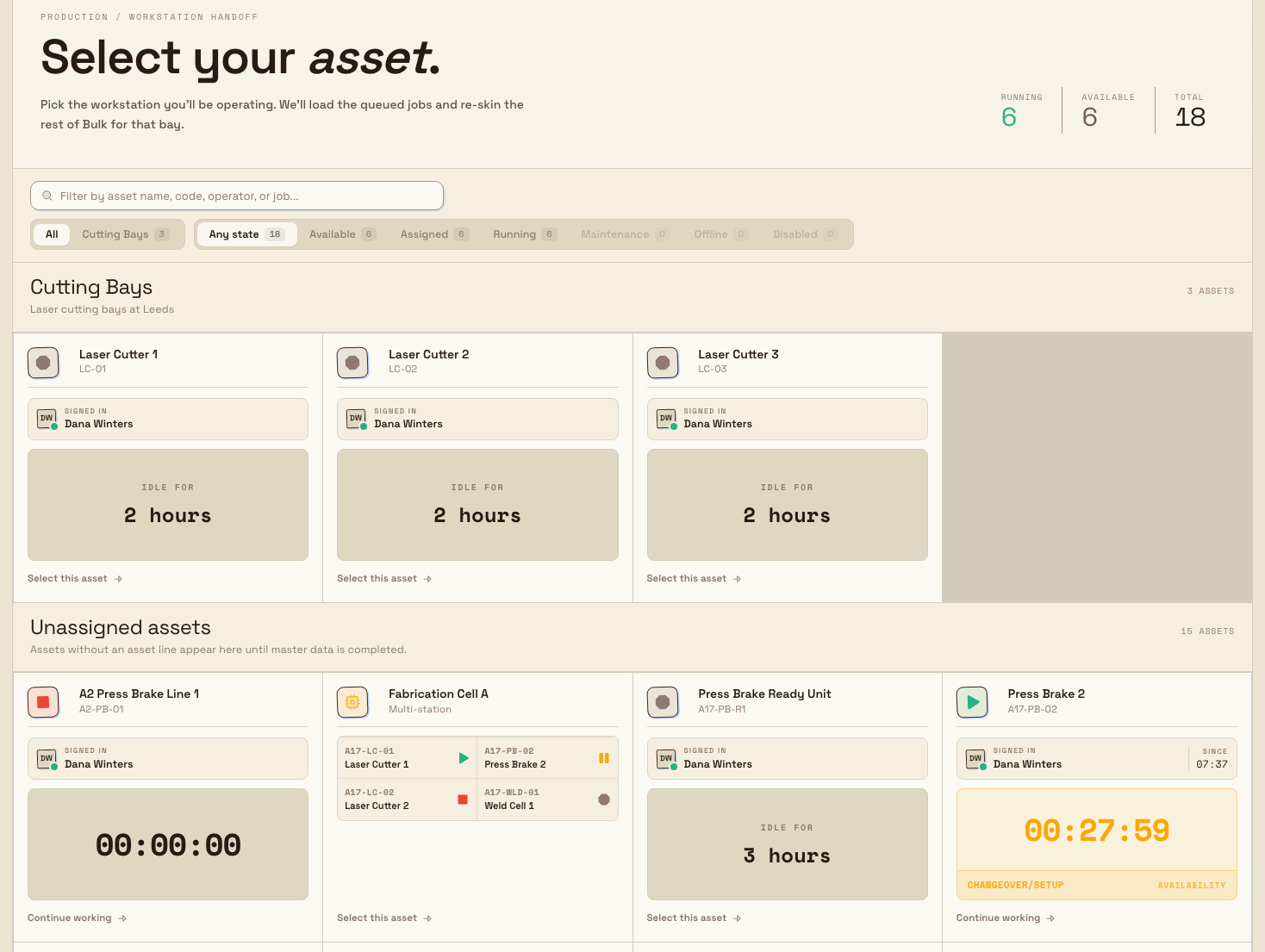
The Select Asset screen is the front door to Bulk's production floor. Before you can load jobs, run timers, or record output, you first pick the piece of equipment you are standing at. In Bulk an asset is a single machine, workstation, or bench, a laser cutter, a press brake, a packing bench, and a workstation is the operator screen that an asset opens into. This screen lists every asset in your plant as a tile, shows what each one is doing right now, and hands you off to the matching operator screen once you choose one.
You use it at the start of a shift, when you move from one machine to another, or whenever you tap the Select asset home button inside a workstation. It is designed for a shop-floor tablet: large tiles, live status, and a single tap to begin.
When you use this screen
Reach for Select Asset whenever you need to start working at a machine:
- Starting a shift. Open the Production area and pick the asset you are operating today.
- Switching machines. Inside any workstation, the header's Select asset home button returns you here to choose a different one.
- Checking the floor at a glance. The tiles show which assets are running, who is signed in, and how long the current job has been going, useful even when you are not about to operate one yourself.
Selecting an asset highlights your choice without changing production data. Choose Operate to open its operator screen; you can return and pick a different asset at any time.
Before you start
Two things need to be in place.
- Permission to view production jobs. The screen is built from the
production_jobs.viewpermission. By default that permission is included in the Super user, Entity admin, Operator, Tablet user, and Invoicing roles. The Manager role does not include it out of the box, so a manager who needs the operator floor has to be granted it by an administrator. If the screen shows an error instead of the asset grid, this permission is the first thing to check. - Assets set up in master data. The grid only shows assets that exist for your current plant (called an entity in Bulk). If none have been created, you see No assets assigned to this entity with a shortcut to Open asset settings. Assets are usually grouped into asset lines, a named group such as a production line or a cell, and each line becomes a section on this screen.
You are always working in one plant
Select Asset shows the assets for the entity you are currently in. If you expect to see a machine that is missing, confirm you are in the right plant before assuming it has not been set up.
Find the asset you need
At the top of the screen, the header shows four live timer counts: Running, Paused, Stopped and Idle. Stopped means work is loaded without a running timer; Idle means no timer work is loaded. Underneath sits the filter toolbar. Its Running filter groups tiles with loaded work, including paused or stopped timers, so its count can differ from the header.
- Search. The box filters tiles as you type. It matches on asset name, asset code, the signed-in operator's name, and the jobs loaded on the asset, the placeholder reads "Filter by asset name, code, operator, or job...".
- Filter by asset line. A row of tabs starting with All lets you narrow to a single asset line. Each tab shows how many assets it holds. The line and state tabs appear on wider screens; compact screens keep the search box.
- Filter by state. A second row of chips filters by what the asset is doing: Any state, Available, Assigned, Running, Maintenance, Offline, and Disabled. Each chip carries a count, and a state with no assets is dimmed.
- Clear. When any search or filter is active, a Clear button resets everything back to the full list.
If your search or filters match nothing, the screen shows No assets match these filters with a Clear filters action to start over.
Read a tile
Each tile stands for one asset (or one multi-station group). Its badge, colour, and body tell you at a glance what you are looking at and whether you can use it.
The tile header shows the asset name and its configured asset type, such as Housing Review Cell or Machining Centre. The status icon and body show what is happening:
- Running shows a live timer, the current operation, customer, order and loaded job items.
- Loaded shows work on the asset with its timer stopped. A loaded job does not mean work is currently running.
- Idle for / Not loaded shows how long the asset has been idle. It can be selected to open its workstation.
- An assigned operator can appear when a station has an active operator session.
- Scheduled downtime with Asset is in maintenance explains why a maintenance tile cannot be selected. Offline and turned-off assets also show their unavailable reason.
Select and open an asset
Selecting is a two-step, tap-to-confirm flow so you do not open the wrong machine by accident:
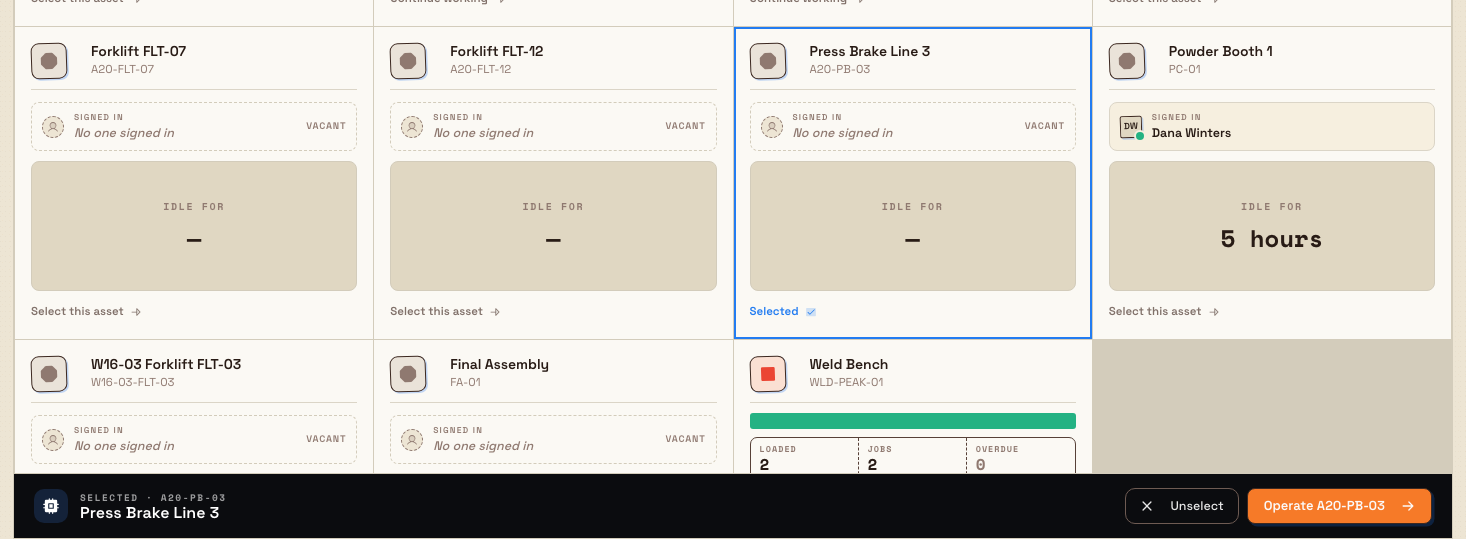
- Tap a tile once to select it. A sticky action bar slides up from the bottom showing Selected [asset code] with the asset's name, an Unselect button, and an Operate [asset code] button.
- Tap Operate [asset code] to open it. Bulk takes you to that asset's operator screen. If you picked the wrong tile, tap Unselect first, or just tap a different tile.
If you already know exactly which asset you want, double-tap the tile to open it directly, that skips the confirm bar and does the same thing as Operate.
Where you land depends on the asset's workstation type: a production tablet or fulfillment asset opens its tablet home for that asset, a Peaking Station opens its scan-and-book screen, and a multi-station opens its grouped operator screen. From any of these, the header's Select asset button brings you back here.
On a production tablet, Home shows the board configured for that asset type. Find the Jobs widget and select Load a job to open the searchable job table. Stage the rows you need in Station capacity, then load them to enter Operate.
Home does not put a job on the asset by itself. Selecting Load a job also does not change production until you confirm the staged rows.
Assets you cannot select
Some tiles are shown but cannot be picked. An asset is unavailable when it is:
- In maintenance, its status is set to maintenance ("Asset is in maintenance").
- Offline, its status is set to offline ("Asset is offline").
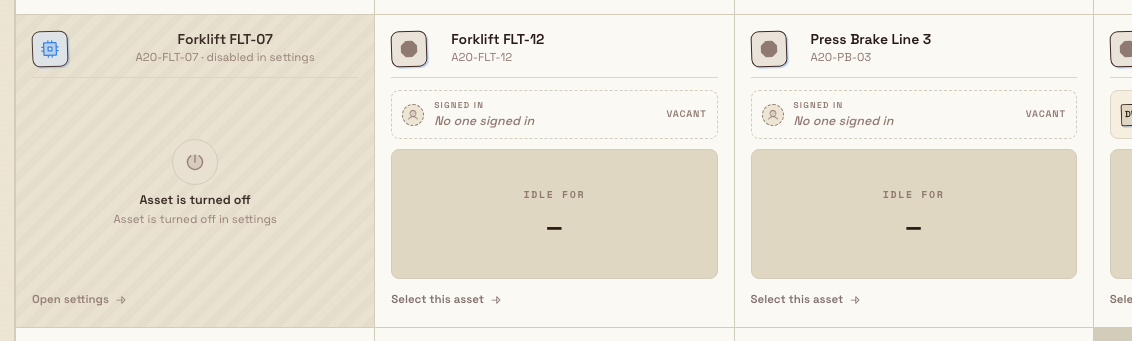
- Turned off, the asset has been deactivated in settings ("Asset is turned off in settings").
These tiles appear dimmed and show their unavailable reason. For example, a maintenance tile reads Scheduled downtime and Asset is in maintenance. You cannot select or open an unavailable tile. This is intentional: it keeps operators off machines that are down or retired. To make one selectable again, an administrator changes the asset's status or re-activates it in Settings → Master Data → Assets.
Example: starting a shift at Gotham Applied Sciences
Bruce opens Production and selects Gotham Housing Cell. Housing Review Bench 1 is already running Assembly for GCPD Fleet Services on job 2026-K42H, while Housing Review Bench 2 is idle and not loaded.
He taps Bench 2 once. The bottom bar confirms Selected GTH-R2, the bench name, Unselect and Operate GTH-R2. He can check the asset code before opening its workstation.
On Gotham Main Line, Gotham Inspection Station shows Scheduled downtime and Asset is in maintenance. That tile stays unavailable until its maintenance status is changed by an administrator.
What you should see
After you tap Operate (or double-tap a tile), Bulk opens the operator screen for that asset, its tablet home, Peaking Station, or grouped multi-station view, with that asset's queued and loaded jobs. Nothing about the asset changes until you take an action on the workstation itself. The header on the workstation keeps a Select asset button so you can return and switch at any time.
Feature state and limits
Select Asset is generally available and is the standard entry point to the production floor.
- Only assets in your current plant appear. The grid is scoped to the entity you are working in; assets in other plants are not shown.
- Unavailable assets are visible but not selectable. Maintenance, offline, and turned-off assets stay in the grid, dimmed, so you can see the whole floor, but you cannot open them.
- Assets with incomplete master data are grouped separately. An asset that has not been assigned to an asset line appears in an Unassigned assets section until its line is set. An asset that has no asset type is not shown at all.
Troubleshooting
- The screen shows an error instead of the asset grid. You most likely lack the View production jobs (
production_jobs.view) permission, or you are signed in with a role, such as Manager, that does not include it by default. Ask an administrator to grant it. - "No assets assigned to this entity." No assets have been created for this plant yet. Use Open asset settings to add asset lines and assets in master data, or confirm you are in the correct plant.
- "No assets match these filters." Your search or filters have hidden everything. Choose Clear filters to show the full list again.
- A tile will not respond when I tap it. The asset is in maintenance, offline, or turned off, so it cannot be selected. An administrator changes its status or re-activates it in Settings → Master Data → Assets.
- An asset I expect is missing. It may have no asset type set, or you may be in the wrong plant. Check the asset in master data.
Related guidance
Production
Understand how the Production area organizes manufacturing work into orders and jobs, and where operators run those jobs at a workstation on the shop floor.
Load a job
Assign one or more production jobs to the asset you are working at so they appear on the operate screen, ready for timing, output, and step completion.