Review an inbound import
Open an upload session from Import History to confirm every uploaded file was read correctly, retry anything that failed, and jump to the inbound documents and production orders it created.
When you upload customer files under Import Documents, Bulk groups that batch into an upload session — a single record of one import that keeps every file in the batch together. Reviewing an import means opening that session afterwards to confirm that each file was read correctly, see how far each one has moved, retry anything that failed, and open the inbound documents and production orders the import created.
An inbound document is the structured record Bulk builds from a customer file (a purchase order, order form, or job sheet), holding the order header and its line items — the individual parts or tasks to make. You review an import right after uploading a batch, to catch any file that did not read cleanly before it becomes production work, and later whenever you need to trace how a particular batch was processed.
The Upload → Inbound → Production pipeline
Every uploaded file moves through three stages: Upload (the file lands in Bulk), Inbound (the file is read and a document with line items is created), and Production (jobs are created from that document's items). The import review screen is built around this pipeline, so at a glance you can see which stage every file in the batch has reached. See the Inbound overview for the full picture.
Where to find it
Open Inbound from the main sidebar, then open Import History. This is the list of every past upload session for the plant — called an entity in Bulk — that you currently have selected. You only see the imports for that plant.
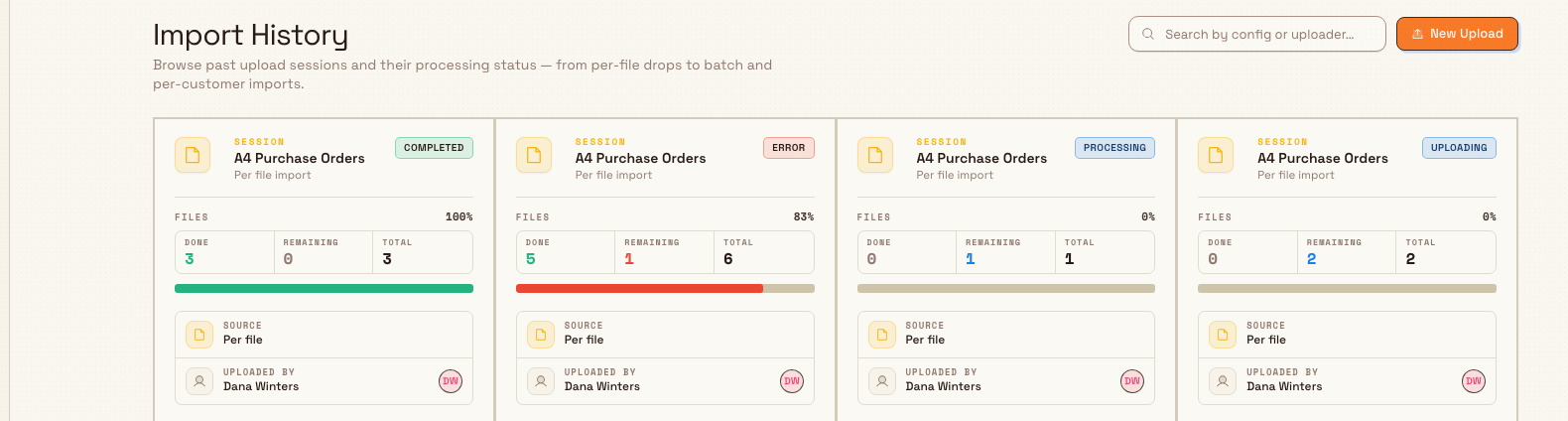
Each session appears as a card showing:
- The Session label and the name of the inbound configuration used.
- The grouping the batch used — Per file, Per session, or Per customer import — which is how the uploaded files were grouped into documents when they were imported.
- A status pill: Initializing, Uploading, Processing, Completed, Error (the batch finished but some files failed), or Cancelled.
- A Files progress strip with Done, Remaining, and Total counts, and who uploaded the batch and when.
Use the search box (Search by config or uploader…) to narrow a long list. Click a card to open that import's detail view. To start a new batch instead, use New Upload, which takes you to Import Documents.
inbound.review-import-01
Before you start
Reviewing an import draws on a few separate permissions, which are set by role. By default the Super user, Entity admin, and Operator roles can do everything on this screen; the exact grants are:
- View upload sessions — needed to open Import History and any import at all. Without it, the session opens as Session not found.
- Retry files — needed to re-run a file that failed to read or failed to build a document.
- Delete upload sessions — needed to cancel a running import or delete a finished one.
These session permissions are separate from the permissions that govern inbound documents. A role can be allowed to approve documents yet still not have access to imports, so if Import History or its actions are missing, this is the first thing to check with your administrator. Roles are configurable per tenant, so treat these as the default grants rather than a guarantee. You also need access to the plant the import belongs to.
What the review screen shows
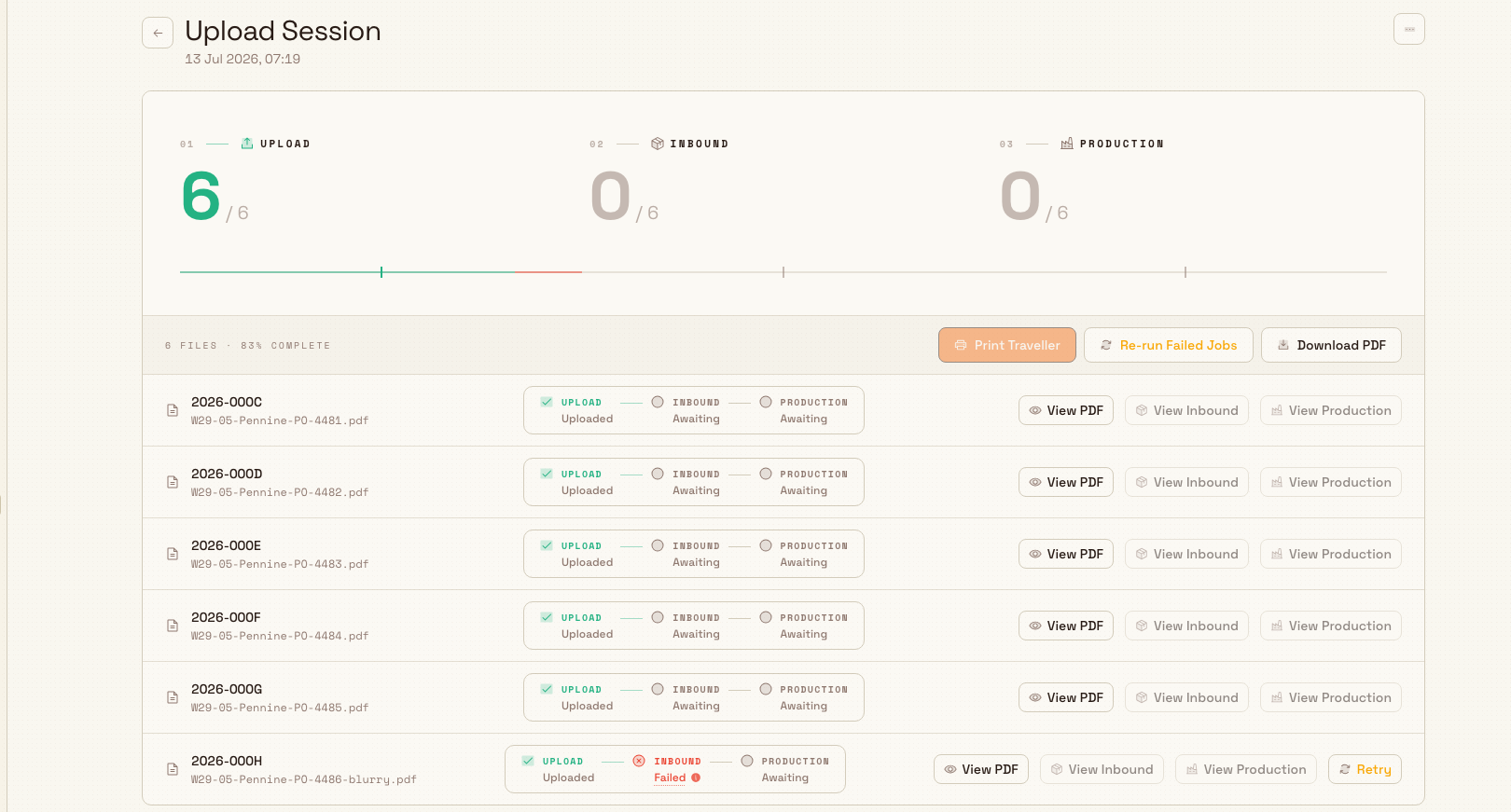
Opening an import takes you to its Upload Session page, dated with when the batch was created. The page has three parts.
inbound.review-import-02
The pipeline board
Across the top, three tiles — Upload, Inbound, and Production — each show a count out of the batch total (for example, 5 / 6). They tell you, at a glance, how many files have been uploaded, how many produced an inbound document, and how many have had production jobs created:
- Upload counts files that finished uploading.
- Inbound counts files that were read and turned into an inbound document.
- Production counts files whose items have become production jobs.
When every file has cleared all three stages with no failures, the board shows a Complete stamp. A tile turns red when files in the batch have failed at that stage, and amber while some are still in progress.
The action toolbar
Below the board, a strip reads n files · x% complete and offers three batch actions:
- Print Traveller — generate the printed travellers (the job cards that travel with work through the shop) for the production orders this import created. It becomes available once at least one file has reached Production.
- Re-run Failed Jobs — re-run the failed step for every file in the batch that can be retried, in one click. It is disabled when nothing in the batch is retryable.
- Download PDF — collect the source PDFs uploaded in this import and download them together as a single ZIP archive.
The file list
Each file in the batch is listed with its file number, how many line items were read from it, and its original filename. A row of badges shows that file's progress through Upload → Inbound → Production, with a short caption under each stage — for example Uploaded, n items, Processing…, n jobs, Failed, or Blocked. Where a stage failed, hovering the badge reveals the reason and the suggested next step.
On the right of each row are quick links, each enabled only when it applies:
- View PDF — preview the uploaded file.
- View Inbound — open the inbound document that was created from this file.
- View Production — open the production order the file's items became.
- Retry — re-run just this file's failed step.
Review an import, step by step
- Open Inbound → Import History and click the import you want to review.
- Read the pipeline board. If all three tiles are full and the Complete stamp is showing, the whole batch processed cleanly.
- Scan the file list for any badge that reads Failed or Blocked. Hover it to see what went wrong.
- For each file that produced a document, click View Inbound to open it and check the extracted values against the original — Bulk reads files automatically (a process called extraction, which uses OCR to pull text off the page), so quantities and part numbers should always be confirmed. See Review an inbound document.
- Retry anything that failed (see below), and use Print Traveller or Download PDF once the batch looks right.
Retry files that failed
A file can stop for one of a few reasons, and only some can be retried from here:
- Extraction failed — Bulk could not read the file. This is retryable.
- Document creation failed — the file was read but the document could not be built. This is retryable.
- Validation failed — the file was rejected before reading (for example, an unsupported file). This is not retryable; upload a corrected file instead.
To retry a single file, click its Retry button. To retry every retryable file in the batch at once, use Re-run Failed Jobs in the toolbar. Bulk queues the work and confirms with a Retry started message; the file's badges update as it re-processes. A file that failed to read but has an automatic retry already scheduled says so in its badge tooltip — you can still retry it immediately.
A Blocked Production badge means the document needs attention
When a file's Production badge reads Blocked, the document was created but its items could not become production jobs — usually because a required value is missing. Click the badge to see which items were blocked, then open the document with View Inbound to fix them. See Promote inbound work to production.

inbound.review-import-03
Cancel or delete an import
Both actions live under the three-dots (actions) menu in the page header and both need the delete permission:
- Cancel Session appears while the import is still running (Initializing, Uploading, or Processing). It stops the batch and marks any file that has not finished as cancelled.
- Delete Session appears once the import has finished (Completed, Error, or Cancelled). On this screen it is only available while the batch's files are still upload-only; once any file has been processed into a document, delete is disabled and the menu shows Cannot delete: files have been processed. Bulk also blocks deletion if any item from the batch has already been promoted to a document or production — those must be archived first.
Deleting an import cannot be undone
Deleting an upload session removes the session and its file records, and Bulk warns that this can't be undone. Cancel a running import if you only want to stop it; delete only when you are sure the batch and its files are no longer needed.
Example: a batch upload at Granite Peak
At Granite Peak Manufacturing's Leeds Fabrication Plant, coordinator Dana Winters uploads six scanned purchase orders from the customer Pennine Rail under Import Documents. Bulk creates one upload session for the batch. A few minutes later, Dana opens Import History and clicks the session, whose status pill reads Error.
The pipeline board shows Upload 6 / 6 but Inbound 5 / 6: one file failed. Scanning the file list, Dana finds a row whose Inbound badge reads Failed — the scan was too blurry to read. Dana clicks Retry on that row, Bulk reports Retry started, and moments later the file reads cleanly and its badges fill in. For the five files that already produced documents, Dana clicks View Inbound on each, confirms the extracted quantities against the original POs, and marks the items ready. With the whole batch now green, Dana uses Print Traveller to produce the job cards for the shop floor — every one traceable back to Pennine Rail's original paperwork.
What you should see
After a successful review, the pipeline board shows full counts on all three stages (and a Complete stamp when nothing failed), every file row shows green stage badges, and each file links through to its inbound document and — once promoted — its production order. Any file that could not be recovered from here is clearly marked, so you know exactly what still needs a fresh upload.
Feature state and limitations
Reviewing imports is generally available. A few things are worth knowing:
- Extraction is an assist, not a guarantee. Always confirm extracted values against the source before the work is approved, especially quantities and part numbers. Poor-quality scans read less reliably.
- Validation failures cannot be retried here. A file rejected at validation must be corrected and uploaded again; only extraction and document-creation failures can be retried.
- Delete is protected. You cannot delete an import once its files have been processed into documents, or once any of its items have been promoted onward.
- Per-card re-run is not available yet. The re-run shortcut on an Import History card is inactive; open the session and use Re-run Failed Jobs to retry a batch.
- Session actions are role-gated separately from documents. Holding document-approval permissions does not by itself grant access to imports; the View, Retry, and Delete session permissions are granted per role.
Related guidance
Import inbound documents
Upload customer files so Bulk reads them automatically and builds inbound documents with their line items already filled in.
Scan and process an inbound item
Scan one inbound item at a station, confirm its fields step by step, then mark it ready, create a production job, and print its label without leaving the screen.