Manage inbound services and items
Add line items to an inbound document and attach billable catalogue services in the grid view to build the document's quote.
An inbound document — the structured record Bulk creates from a customer's purchase order, delivery note, or job sheet — breaks down into line items: the individual parts, materials, or products on that order. Services are the billable work you add on top of those items — tests, treatments, finishing, or handling — that you author once on the document and then attach to the line items they apply to. Together, items and services make up the document's quote: the priced picture of what the customer is charged.
Use this screen when an inbound order needs priced work beyond the parts themselves. A plate arrives that must be laser-cut and tensile-tested; a casting needs shot-blasting and a certificate. You capture the parts as line items, add each service once, and assign it to the items it covers — instead of retyping the same charge on every line.
Services live in the grid view
The Services panel is part of the inbound document grid view (the newer, spreadsheet-style layout, also called Document view V2). Open a document from Inbound Documents and switch to the grid view to see it. The classic document view shows each item's base pricing but has no Services panel. For the overall layout and how to open it, see Work in the document grid.
Before you start
- Open a document in the grid view. The Services panel and the per-item Services column appear only there.
- You need the Edit inbound documents permission (
inbound_documents.update) to add, edit, or assign services and to edit line items. Without it a document opens read-only. The built-in Operator, Manager, Entity admin, and Super user roles include it by default. - Picking a service code from the registry needs the View service codes
permission (
service_codes.view). Without it you can still author a free-text service; you just cannot attach a registered code to it. - The document must be editable. Services and items can only be changed while the document is in Draft or In progress, and not while it is locked or on hold. In any other status the controls are hidden or disabled.
- Catalogue services and rate templates come from Settings. The From
catalogue and Apply template actions read from Settings → Master Data →
Pricing and require View pricing agreements (
pricing.view). If they are empty, set them up there first — see Set up pricing.
Line items
A line item is one row of work on the document — a part, a quantity, and its price. Each item carries three base pricing fields:
- Quantity — how many units the line covers.
- Unit Price — the price for one unit, in the document's currency.
- Total Price — the line total for the base part.
You add and edit items in the Document items grid lower down the same screen. Items can also carry custom fields your plant has defined. Because item editing is a topic of its own, this article focuses on services and how they attach to items; for the full item-editing workflow see Edit an inbound document and Fill in custom fields.
Services are separate from item base price
Adding a service to an item does not change that item's Total Price. Base pricing (Quantity × Unit Price) stays with the part; services are billed alongside it on the document's quote. This keeps "what the part costs" and "what the work costs" clearly separated.
Services
The Services panel lists every service defined on the document. Each service has a short row ID (SVC-01, SVC-02, …), a name, an optional colour tag, and one or more billing lines — the individual charges that make up the service (for example a fixed setup charge plus a per-sample charge). The table columns are ID, Service (or Service code when you pick from the registry), Line item, Qty, Price, Unit, and Used by (how many document items the service is assigned to).

inbound.services-items-01
You add services in three ways, using the buttons in the panel header:
- Add service — creates a blank service row on the document. Type its name directly in the grid, then add billing lines with Add line item. Each line can be a fixed money amount (with a Qty and Unit) or a percent of the service subtotal. Use this for one-off work that is not in your catalogue.
- Apply template — opens the Apply pricing template dialog. Pick a saved rate template (a preset bundle of services and charges from the Pricing module) and Bulk copies it in as one service named after the template, with the template's base price, bundled services, and additional charges as its billing lines. The copy is a snapshot: later edits to the template do not change what you have already added. Filter templates by This customer, General, Other customers, or All.
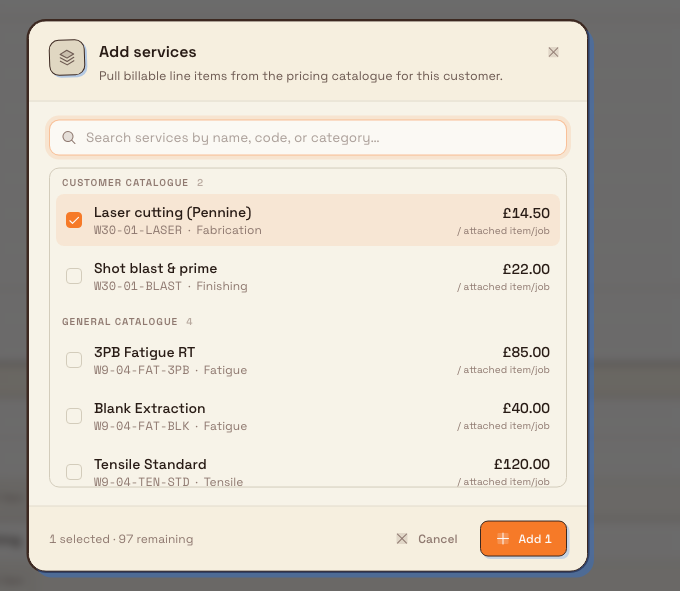
- From catalogue — opens the Add services dialog. Search your billable catalogue services, grouped into Customer catalogue (scoped to the document's customer) and General catalogue. Select one or more, and each becomes its own service on the document.
Template vs. catalogue
Reach for Apply template when a customer or job type always needs the same bundle of services — it lands as a single, pre-costed service. Reach for From catalogue when you want to pick individual services one at a time. Both read from Settings → Master Data → Pricing, so the tidier that catalogue is, the faster this step becomes.
Add a service priced from process hours
A catalogue service can use the Timed / process hours pricing model when its charge must come from time recorded on production jobs. Timed services are deliberately hidden from an inbound document's From catalogue dialog: an inbound document has no jobs whose time Bulk could bill.
To use one:
- Submit the inbound document to production.
- Open the resulting production order and select its Jobs tab. In the Services panel above the jobs table, select From catalogue and add the timed service.
- In the jobs table, assign the service to every job whose time it should bill.
- Select the service's locked Qty at any time — including while it shows 0 — to open Timed service, the per-job process-hours breakdown.
The breakdown has Timer, Manual, Adj, OEE, Billable h, and Amount columns. Only time sources and routing resources enabled in the service's Pricing setup contribute. Each assigned job gets its own row; an assigned job with no included time shows a zero row. If no jobs are assigned, the dialog instead says: No process hours yet. Hours appear when timers stop (or manual time is entered) on jobs assigned this service. A row marked incomplete means the service is restricted to resources that do not occur in that job's routing.
See the populated breakdown in Review a timed service by job.
Bulk refreshes the locked quantity and amounts after service or job assignment changes, after a timer stops, after manual time or an adjustment is entered, and after qualifying OEE downtime closes. A running timer is not previewed, so its time appears only after the timer stops. Billable hours and amounts are rounded per job; the service total is the sum of those per-job amounts.
Pricing setup is snapshotted
Settings → Master Data → Pricing supplies the starting hourly rate, allowed time sources, and chargeable resources. Bulk snapshots that timed configuration when you add the service to the production order, so later catalogue changes do not rewrite the order. The rate can still be edited on an editable order; the time-source and resource rules cannot. See Set up pricing.
Production permissions and locks
Opening the order needs View production orders (production_orders.view).
Adding or editing its service needs Edit production orders
(production_orders.update) and browsing From catalogue also needs
pricing.view. Assigning the service to jobs additionally needs Edit production
jobs (production_jobs.update). A completed order is read-only. Completed,
cancelled, deleted, awaiting-approval, or invoiced jobs cannot have service
assignments changed, and a submitted invoice can lock an affected service.
inbound.services-items-02
Assign services to items
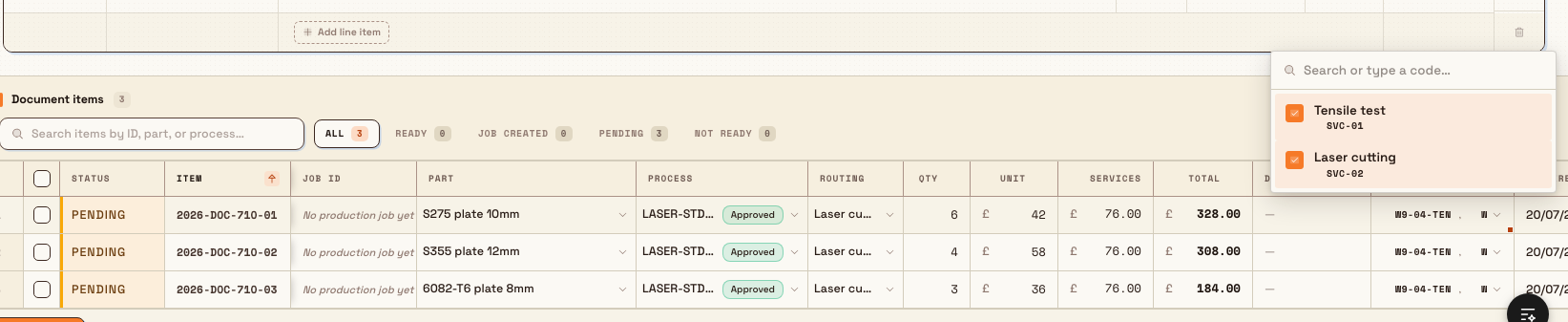
Defining a service does not bill it yet — you attach it to the line items it applies to. Every item row in the Document items grid has a Services cell showing — assign when nothing is attached, or coloured chips listing the assigned service codes.
- In the Document items grid, click the Services cell on the line item you want.
- In the popover, use Search or type a code… to find a service, then click it to toggle it on or off. A tick marks the services attached to that item.
- Repeat for other items. Each service's Used by count in the Services panel updates to show how many items it now covers.
To attach the same service to many items at once, select the item rows (their checkboxes) and use Apply service in the bulk action bar that appears.
inbound.services-items-03
Example: a cutting-and-testing order at Granite Peak
Granite Peak Manufacturing's Leeds Fabrication Plant receives a delivery from a steel stockholder: three grades of plate that must be laser-cut to a drawing and tensile-tested to certify the material. A coordinator opens the inbound document in the grid view.
- Line items. Each plate grade is a line item with its Quantity, Unit Price, and Total Price — the cost of the material itself.
- Services. In the Services panel the coordinator uses From catalogue to add Laser cutting and, because tensile testing is a standard bundle for this customer, Apply template to bring in a Tensile test service with its setup and per-sample billing lines in one step.
- Assignment. Laser cutting applies to every plate, so the coordinator selects all item rows and uses Apply service to attach it in one action. The tensile test applies only to the two certified grades, so those get the service from their Services cell.
The document's quote now reflects the plate cost plus the cutting and testing work, with each service's Used by count showing exactly how many lines it covers — no charge retyped, and material cost kept separate from service cost.
Expected result
- The services you added appear as rows in the Services panel, each with its billing lines.
- Every item you assigned a service to shows the service's coloured chip in its Services cell.
- Each service's Used by count matches the number of items it is attached to.
- The document's quote reflects both the line items' base pricing and the assigned services. Changes save automatically as you edit.
Feature state and limitations
This capability is generally available in the inbound document grid view. Keep these boundaries in mind:
- Current document workspace only. Services are managed in the inbound grid.
- Editable states only. You can add, edit, or assign services only while the document is in Draft or In progress, and not while it is locked or on hold.
- Limits. A document can hold up to 100 services; each service can have up to 20 billing lines; and each line item can have up to 20 services assigned. Bulk stops you at these limits with a message.
- Services do not roll into item totals. They are billed on the document's quote and are deliberately kept out of each item's Total Price.
- Timed services are added after promotion. They do not appear in the inbound document catalogue picker. Add them from the production order's Jobs tab. An order can hold up to 100 services and each service up to 20 billing lines, with at most one Timed / process-hours line per service.
Troubleshooting
- The Add service / Apply template / From catalogue buttons are missing or greyed out. The document is probably not editable — check that it is in Draft or In progress and is not on hold or locked — or your role lacks the Edit inbound documents permission. Ask an Owner or Entity admin to grant it or to release the hold.
- You cannot pick a service code. Choosing a registered code needs the View service codes permission. You can still type a free-text service name without it.
- The catalogue or template list is empty. Nothing has been set up yet in Settings → Master Data → Pricing. Add catalogue services and rate templates there, then reopen the dialog — the Add services empty state links straight to the pricing catalogue.
- A service will not save. Each service needs a name (or a registry code) and at least one billing line with a price; removing a service's last line removes the whole service rather than leaving a blank row.
- A timed service still shows 0 hours after production starts. Check that you added it to the production order, assigned it to the correct jobs, and that its snapshotted Pricing setup includes the recorded time source and routing resource. A running timer does not change the quantity until it stops. If the per-job row says incomplete, the selected resources do not occur in that job's routing.
Related
Submit or cancel inbound approval
Send an inbound document for sign-off when its routing requires approval, and cancel a pending approval by withdrawing it so the document unlocks for edits.
Attach files to inbound work
Add PDF references — purchase orders, drawings, and specs — to an inbound document, view them beside your line items, and manage them while the document is still editable.