Update organization settings
Set your organization's name, timezone, and language, review your sites, manage the legal entities used on invoices, and control which import types your team can use.
In Bulk, your organization is your whole company workspace — every site, every user, and the shared settings that apply across all of them. An entity (also called a site or plant) is a single manufacturing location inside that organization. The Organization Settings page is where you set the details that belong to the organization as a whole rather than to any one site: its name, its timezone and language, the list of sites it contains, the legal entities used on invoices, and which import types your team can use.
Use this page when you are setting up a new workspace, when your company rebrands or changes its trading name, when you move to a new default timezone, or when you need to add the legal and tax identity that appears on customer invoices.
The page groups everything into five tabs — General, Localization, Entities, Legal entities, and Imports — and this guide walks through each one.
Before you begin
Different tabs on this page are protected by different permissions. A permission is a named right that a role grants; roles are assigned to users. See Manage roles and permissions for how these grants work.
- Editing the organization name, localization, and legal entities requires the Edit organization settings permission (
organization.update). By default this permission is held only by the built-in Super user role. Other administrative roles such as Entity admin and Manager can open the page but do not carry this permission, so their attempts to save a name, timezone, or legal-entity change are refused. - Managing import availability requires the separate Manage imports permission (
imports.manage). This is held by the Super user, Entity admin, and Master data roles. - Localization applies to your whole organization. The timezone and language you set here are organization-wide defaults, not per-site values. Each site also has its own timezone, shown on the Entities tab.
The name and localization fields always look editable
On the General and Localization tabs the input fields are never greyed out, even for a user without the Edit organization settings permission. If you lack that permission the fields still accept typing, but selecting Save Changes or Save Localization fails with a permission error rather than saving. If a save is refused, ask a Super user to make the change.
Open organization settings
Go to Settings → Organization → Settings. The page header reads Organization Settings with the subtitle "Manage your organization's appearance, localization, and preferences." Unlike some neighbouring pages, this one carries no Beta label — it is a generally available part of Bulk.
Across the top of the page is a tab bar with five tabs: General, Localization, Entities, Legal entities, and Imports. Select a tab to switch between them; the page opens on General.
administration.organization.general-01
General: name and slug
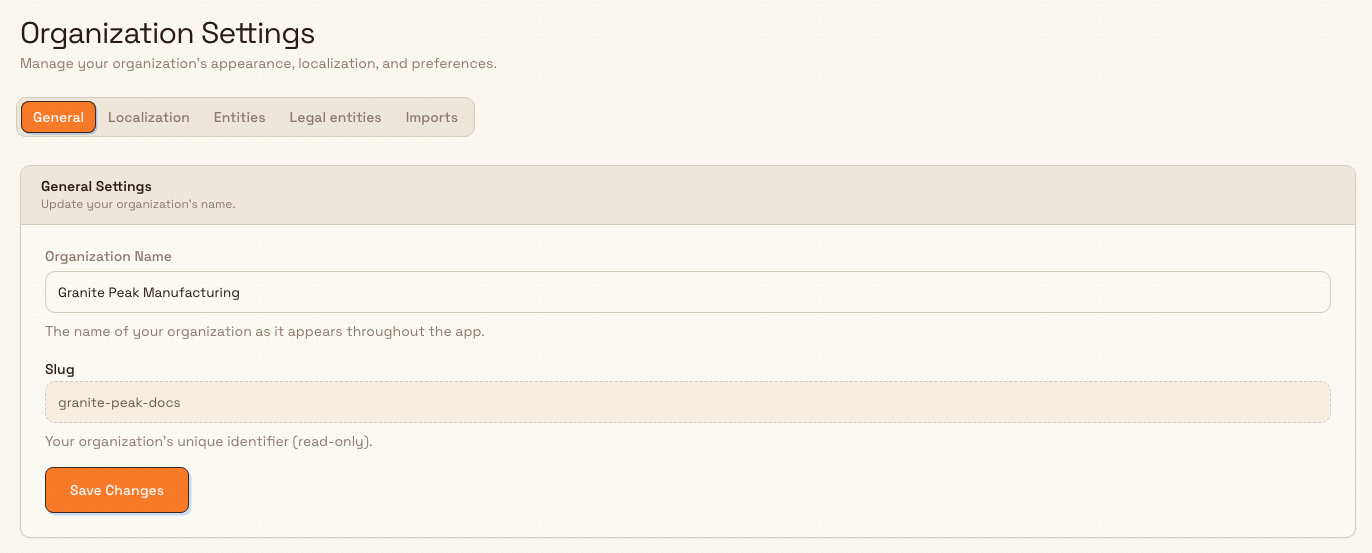
The General tab holds the General Settings card, described as "Update your organization's name." It has two fields.
- Organization Name — the name of your organization as it appears throughout the app. Enter a name between 3 and 100 characters. On a brand-new workspace the field starts with a placeholder of
My Organization. - Slug — your organization's unique identifier, shown read-only. The slug is fixed and cannot be edited here; it is the short identifier that appears in your workspace web address.
Change the name and select Save Changes (the button reads "Saving..." while it works). A success message, Settings updated — "Organization settings have been saved successfully." — confirms the change, and the new name takes effect across the app. Each change is recorded for audit and appears in your activity logs.
Localization: timezone and language
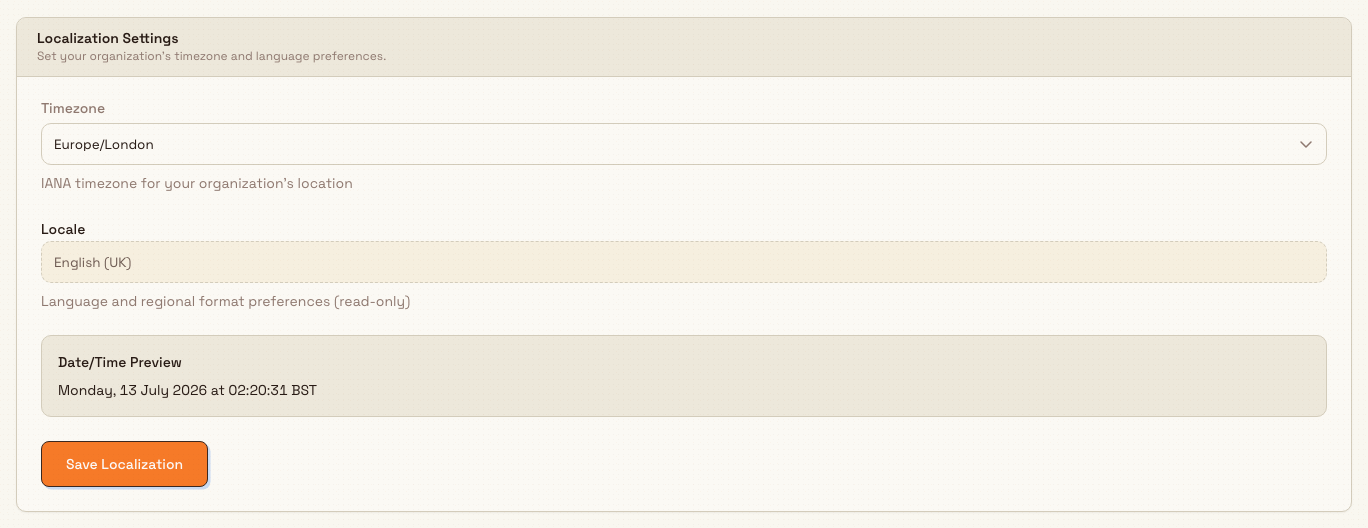
The Localization tab holds the Localization Settings card, described as "Set your organization's timezone and language preferences." It controls how dates and times are shown across your organization.
- Timezone — choose from a list of common IANA timezones (for example
UTC,Europe/London,America/New_York,Asia/Tokyo,Australia/Sydney). IANA is the standard naming system for timezones. The helper text reads "IANA timezone for your organization's location." This list is a curated set of common zones rather than the full worldwide list. - Locale — shown read-only as English (UK). Language and regional formatting are currently fixed to English (UK) and cannot be changed here.
- Date/Time Preview — a live sample below the fields showing the current date and time formatted for the timezone you have selected. Use it to confirm you picked the right zone before saving.
Select Save Localization to apply the timezone. A success message, Localization updated, confirms it, and the change is recorded in your activity logs.
administration.organization.general-02
Entities: review your sites
The Entities tab lists every site (entity) in your organization in a read-only table. You create and rename sites elsewhere — this tab is for reviewing them and linking each one to a legal entity. Each row shows:
- Name and Code — the site's display name and short code.
- Legal entity — which legal entity the site belongs to (see the next section). If the site is not yet linked, this cell shows an Unassigned selector you can use to assign one.
- Entity ID — the site's internal identifier, with a copy button so you can paste it into a support request or an integration.
- Timezone — the site's own timezone.
- Status — active or inactive.
If no sites exist yet, the tab shows "No entities found." with a note to add entities from the entity management page.
Assign a site to a legal entity
To link a site to a legal entity, open the Legal entity selector on that site's row and choose one. Bulk shows a confirmation with a preview of what will change, then merges the site into that legal entity. While the merge runs the row shows a Merging… badge; if it fails it shows a Failed badge with a Retry action.
Assigning a legal entity is a one-way change on this page
Once the assignment finishes, the site's legal entity is locked here: the row becomes a read-only label and the selector no longer appears, so you cannot reassign it from this page. Assign carefully. If a target legal entity is still merging another site, Bulk shows "Legal entity is busy" — wait for that merge to finish, then try again.
Legal entities: invoicing identities
A legal entity is the registered company that trades with your customers — the name, tax registration, and bank details that appear on an invoice. One legal entity can own several sites. The Legal entities tab lists them in a table with Name, Code, Country, a Plants count (how many sites belong to it), and per-row Edit and Archive actions. A legal entity with one or more plants cannot be archived, so its Archive action is disabled. If none exist yet, the tab shows "No legal entities yet."
Create or edit a legal entity
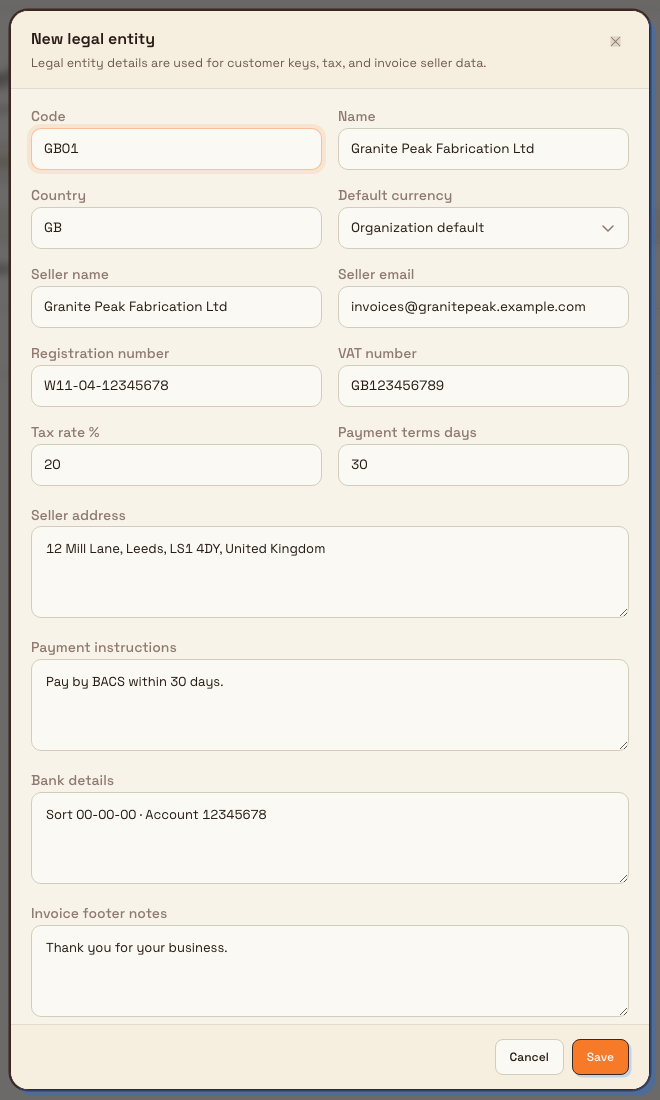
Select New legal entity (the button in the page header while the Legal entities tab is active) to open the create dialog, or select the Edit (pencil) action on a row to change an existing one. The dialog explains that "Legal entity details are used for customer keys, tax, and invoice seller data" and offers these fields:
- Code and Name — both required; the code is stored in upper case (for example
GB01). - Country — a two-letter country code, such as
GB. - Default currency — the currency used for this legal entity's invoices, or Organization default.
- Seller name, Seller email, Seller address — the seller details printed on invoices.
- Registration number and VAT number — the company's registration and tax numbers.
- Tax rate % and Payment terms days — the default tax rate and payment window applied to invoices.
- Payment instructions, Bank details, and Invoice footer notes — free-text blocks that appear on invoices.
Select Save to create or update the legal entity; a confirmation such as "Legal entity created." appears. These details feed the invoicing profile used when Bulk generates invoices — see Configure an invoicing profile for how a site uses them.
administration.organization.general-03
Imports: control available import types
The Imports tab shows the Import Settings card — "Manage which import types are available to your team." Each import type (for example a spreadsheet importer for a particular kind of record) has a row with its name, a short description, and an on/off switch. When a type is on, the row notes who enabled it and when — for example "Enabled by Dana Winters on Jul 8, 2026". A footer summarises the total, such as "3 of 8 import types enabled".
- Turn a type on or off with its switch. Bulk confirms with a message such as "... import enabled".
- Select Enable All (shown while some types are still off) to switch on every import type at once.
- If you do not have the Manage imports permission, the tab shows a Read-Only Access notice and the switches are disabled — you can see which types are available but not change them.
This tab controls availability only. For the full guide to configuring import types, see Configure import availability; to actually upload files and run an import, see Run data imports.
Example: Granite Peak Manufacturing
Granite Peak Manufacturing has just moved onto Bulk. Dana Winters, a Super user, sets the organization up from this page:
- On General, Dana enters the name
Granite Peak Manufacturingand selects Save Changes. The confirmation Settings updated appears and the new name shows in the sidebar. - On Localization, Dana sets the Timezone to
Europe/London. The Date/Time Preview shows the correct UK date and time, so Dana selects Save Localization and sees Localization updated. - On Legal entities, Dana selects New legal entity and creates
Granite Peak Fabrication Ltd(codeGB01, countryGB), with the company's VAT number, registered address, a default currency of British pounds, and 30-day payment terms — the details that will print on customer invoices. - On Entities, Dana opens the Legal entity selector on the Leeds Fabrication Plant row, chooses
GB01 / Granite Peak Fabrication Ltd, and confirms. The row shows Merging…, then settles into a locked, read-only label once the assignment completes. - On Imports, Dana selects Enable All so the team can import customers, parts, and assets while the rest of the setup continues.
The workspace now shows the right company name and timezone everywhere, invoices will carry the correct seller and tax details, and the Leeds site is tied to its legal entity.
Expected result
Saving the General or Localization tab updates your organization immediately: the new name appears across the app, and dates and times follow the timezone you chose. A legal entity you create appears in the Legal entities table and is available to assign to sites and to invoicing. Assigning a site to a legal entity links the two once the merge completes. Enabling an import type makes it available to your team on the imports screens. Every change on this page is recorded in your activity logs.
Feature state and limits
Organization Settings is generally available; keep these verified points in mind.
- Only the Super user role can edit name, localization, and legal entities by default. The
organization.updatepermission behind these tabs is not granted to Entity admin or Manager out of the box. Grant it to a custom role if you need others to make these changes. - The timezone list is a curated set of common zones, not the full worldwide IANA list. If your exact zone is not offered, choose the nearest listed zone in the same offset.
- The language and locale are fixed to English (UK) and shown read-only; you cannot change them from this page.
- The organization slug is read-only here and cannot be edited on this tab.
- Assigning a site to a legal entity locks that link on this page. After the merge completes there is no control to reassign the site from here.
- Import availability is controlled here, but running imports happens elsewhere — see the linked import guides.
Troubleshooting
- Save is refused with a permission error on General or Localization. Your role can open the page but lacks the Edit organization settings permission (
organization.update). Ask a Super user to make the change, or have that permission added to your role. - The Legal entity selector is missing on a site's row. The site is already assigned and locked, or an assignment is in progress. A locked site shows a read-only legal-entity label instead of a selector.
- "Legal entity is busy" appears when assigning a site. Another site is still being merged into that legal entity. Wait for it to finish, then try the assignment again.
- The Archive action on a legal entity is greyed out. That legal entity still owns one or more sites (its Plants count is above zero). Reassign or remove its sites first, then archive it.
- The Imports tab shows "Read-Only Access". You do not have the Manage imports permission (
imports.manage). Ask an administrator with a Super user, Entity admin, or Master data role to change import availability. - The timezone you saved does not match a site's clock. This page sets the organization-wide default; each site has its own timezone on the Entities tab, which can differ.
Related
- Organization settings overview — the full set of organization-wide settings.
- Manage roles and permissions — grant the Edit organization settings or Manage imports permissions.
- Configure an invoicing profile — how a site uses legal-entity details on invoices.
- Configure import availability and Run data imports — the full import guides.
- Update entity settings — the per-site settings that complement these organization-wide ones.
- Configure working hours, Manage units, and Manage currencies — other organization-wide settings.
Organization settings
The organization-wide settings that apply across every site in your Bulk tenant — your organization's name and localization, its sites and legal entities, and shared configuration for units, currencies, working hours, displays, imports, workflow automation, and access.
Configure localization
Set your organization's default timezone and review the fixed English (UK) display language and regional format on the Localization tab of Organization settings.