Record consumable use
Record the consumables an operator uses against the jobs loaded at a workstation, using the Log Material tool on the production operate screen.
Recording consumable use captures the materials an operator spends while running a job — things like adhesives, coatings, welding wire, tape, or packaging. Consumables are the supporting materials you draw on during production but do not track as finished parts. Logging them keeps an accurate cost and quantity trail against each job, and — when you track stock for a consumable — draws the amount you used down from its stock level.
You record consumable use from the production operate screen: the touch-friendly workstation view an operator uses while working a station. The main tool is the Log Material dialog, reached from the Operator Tools panel.
When to record consumable use
Record consumable use whenever an operator consumes material against the jobs currently loaded at a workstation. Typical moments are:
- Part-way through a run, when a fresh box, roll, or cartridge is opened.
- At the end of a phase, to book everything the batch consumed in one go.
- Automatically as part of recording output, when the workstation's workflow includes a consumable step (see below).
Before you start
You need all of the following:
- A workstation with a job loaded. Consumables are always booked against the jobs in the workstation's current batch. If nothing is loaded, load a job first. See Load a job.
- Consumables and their variants set up. An administrator must have created the consumables and at least one variant (a specific version of a consumable, such as a colour or pack size, that carries the unit cost) in Settings under Master data → Consumables. See Consumables and variants.
- Permission to add consumable usage. Recording is gated by the
production_operate.consumables_addpermission. In a standard setup this permission is granted to the Super user, Entity admin, Tablet user, and Master data roles. The general Operator and Manager roles do not carry it by default.
Log material against the loaded batch
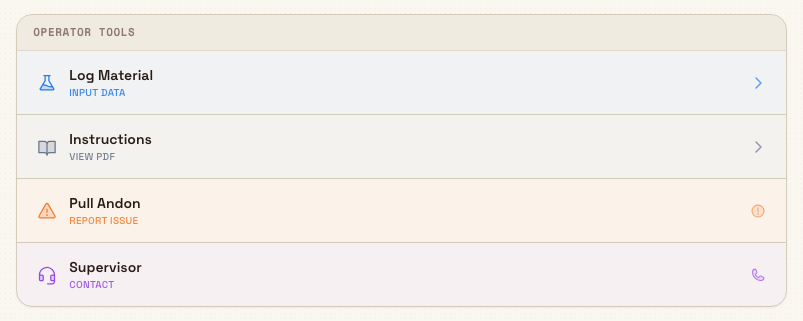
From the workstation's operate screen, find the Operator Tools panel. It always shows a Log Material button (marked Input Data).
production.record-consumables-01
- Select Log Material. If no job is loaded, you see the message "No jobs loaded. Load a job first to log materials." — load a job and try again.
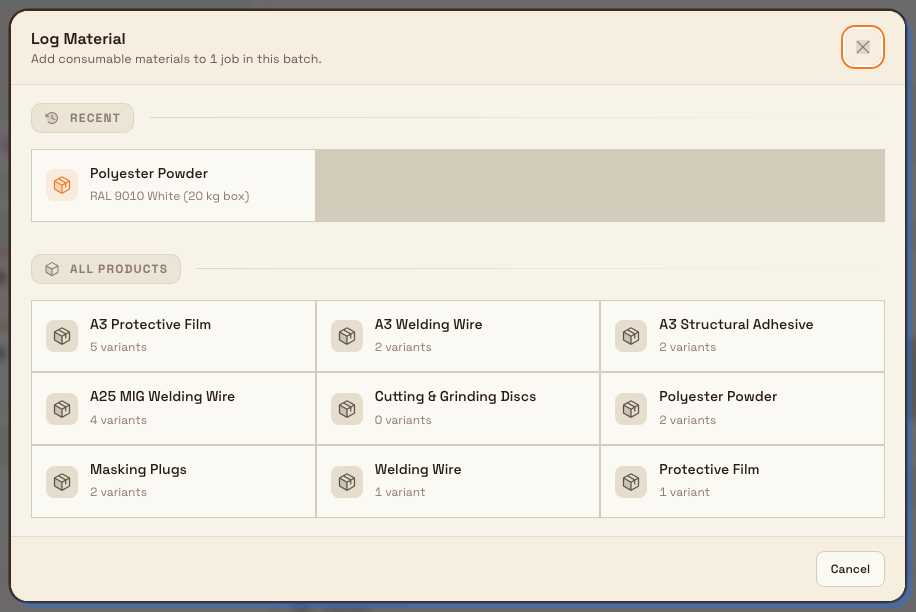
- The Log Material dialog opens. It lists a Recent row (consumables used recently at this workstation, for quick re-logging) and an All Products grid of every active consumable.
production.record-consumables-02
- Pick what you used:
- Tap a Recent tile to add that consumable and variant straight to your cart.
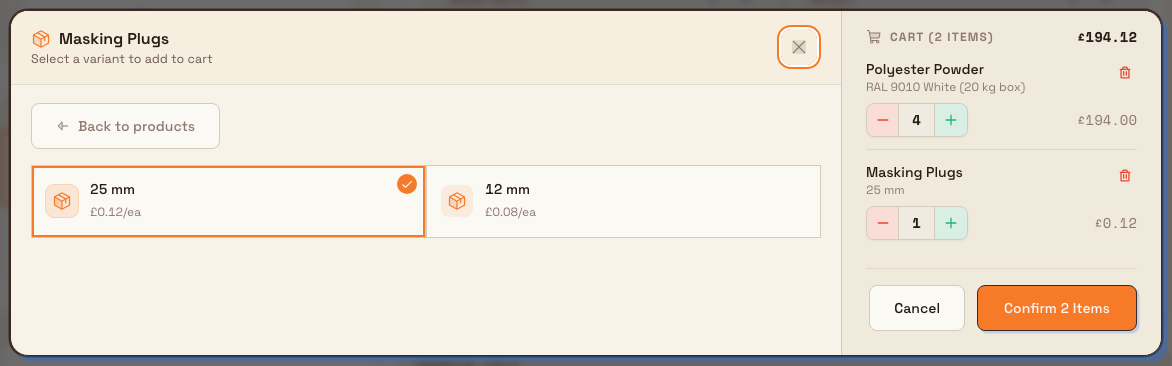
- Or tap a product in All Products to open it, then choose a variant ("Select a variant to add to cart"). Each variant tile shows its per-unit cost. Use Back to products to return to the full list.
- Every item you pick appears in the Cart panel. Set how much you used with the plus and minus buttons on each cart row, remove a row with the delete (bin) button, and watch the running cost total update as you go.
- When the cart reflects everything the batch consumed, select the Confirm button (its label shows how many items are in the cart).
production.record-consumables-03
On success you see a "Logged" confirmation naming what was booked, and the dialog closes.
Quantity is shared across every job in the batch
The amount you enter for a consumable is split evenly across all the jobs currently loaded at the workstation. If you log two boxes of powder against a batch of three jobs, each job records two‑thirds of a box. Book against a single loaded job when you need the whole amount tied to one job.
Your cart is held for the current workstation and batch in this browser session, so if you close the dialog before confirming, the items you had queued are still there when you reopen it. Confirming clears the cart.
Record consumables while recording output
If a workstation's workflow includes a consumable step, you can book a consumable at the same time you record production output, without opening Log Material separately. When you record output, the workflow shows a consumable picker; the consumable you choose is booked with a quantity equal to the output quantity you entered. This is useful when one unit of output always uses a fixed amount of a material. For the output flow itself, see Record production output.
Example: powder coating at Leeds Fabrication Plant
Priya, a line operator at Granite Peak Manufacturing's Leeds Fabrication Plant, is running the Powder Coat Booth workstation. Three bracket jobs are loaded in the current batch. After spraying, she records what the batch used:
- On the operate screen she selects Operator Tools → Log Material.
- Under Recent she taps Polyester Powder — RAL 9010 White (20 kg box) from yesterday's run; it lands in her cart at quantity 1. She taps plus once to make it 2 boxes.
- In All Products she opens Masking Plugs, chooses the 25 mm variant, and sets the quantity to 6.
- The cart shows a running material cost. She selects Confirm.
Bulk records the usage against all three jobs, splitting each quantity three ways, and snapshots the current cost of each variant so the batch's material cost is accurate even if prices change later.
What gets saved
When you confirm, Bulk creates a consumable-usage record for each job in the batch. Each record captures:
- The consumable and the exact variant used.
- The quantity for that job (the total you entered, divided by the number of jobs in the batch).
- A cost snapshot — the variant's unit cost at the moment you recorded, and the resulting value. Later price changes in Settings do not alter past records.
- The workstation, the operator, and a timestamp.
If the consumable has stock tracking, the amount you booked is drawn down from its stock level, producing a stock movement. See Stock levels.
Review or correct a recording
Recorded consumables appear in the Materials Used list on the job card at the workstation, grouped by variant with a total quantity.
To fix a mistake, tap a material to open Material Usage Details, then use Edit Batch to change the recorded quantity or Delete Batch to remove a recording. Deleting or reducing a recording reverses the matching stock movement. For the full picture of viewing and adjusting production records, see Transactions.
Deleting a recording is permanent
Delete Batch removes the usage records for that recording and reverses the associated stock draw-down. There is no undo — re-log the material if you delete it by mistake.
Limitations and behaviour to know
- Even split only. From the Log Material dialog you cannot set a different amount per job; the total is always divided evenly across the loaded jobs. To tie a whole amount to one job, load only that job.
- Whole-number steppers in the cart. The Log Material cart adjusts quantities up and down by one; there is no free-text quantity field there. (You can set a corrected value later through Edit Batch.)
- Stock deduction is best-effort. Recording consumable use always saves the usage record. If a consumable has no stock tracking, or the stock draw-down cannot complete, the usage is still recorded — so a saved usage does not guarantee a matching stock movement.
- Cost is a snapshot. The cost stored with each record is the variant's unit cost at record time, not a live value.
Troubleshooting
- "No jobs loaded. Load a job first to log materials." — The workstation has no active batch. Load a job or select a workstation that has work loaded, then reopen Log Material.
- "No consumables configured" / "Add consumables in Settings to log materials." — No consumables exist yet for this facility. An administrator needs to add them under Master data → Consumables. See Consumables and variants.
- The Log Material button does nothing useful, or you cannot confirm. — Confirm your account has the
production_operate.consumables_addpermission (Super user, Entity admin, Tablet user, or Master data roles by default). Ask an administrator if you are unsure.
Related guidance
Record production output
Record how many units a job produces at a workstation using the on-screen production counters and the Record Output dialog.
Complete production quality steps
Log a defect or quality reason on the tablet by completing the Quality Check step that appears when you record production output.